Regional Office Power Rankings 2025: Which VA Office Processed Claims Fastest?
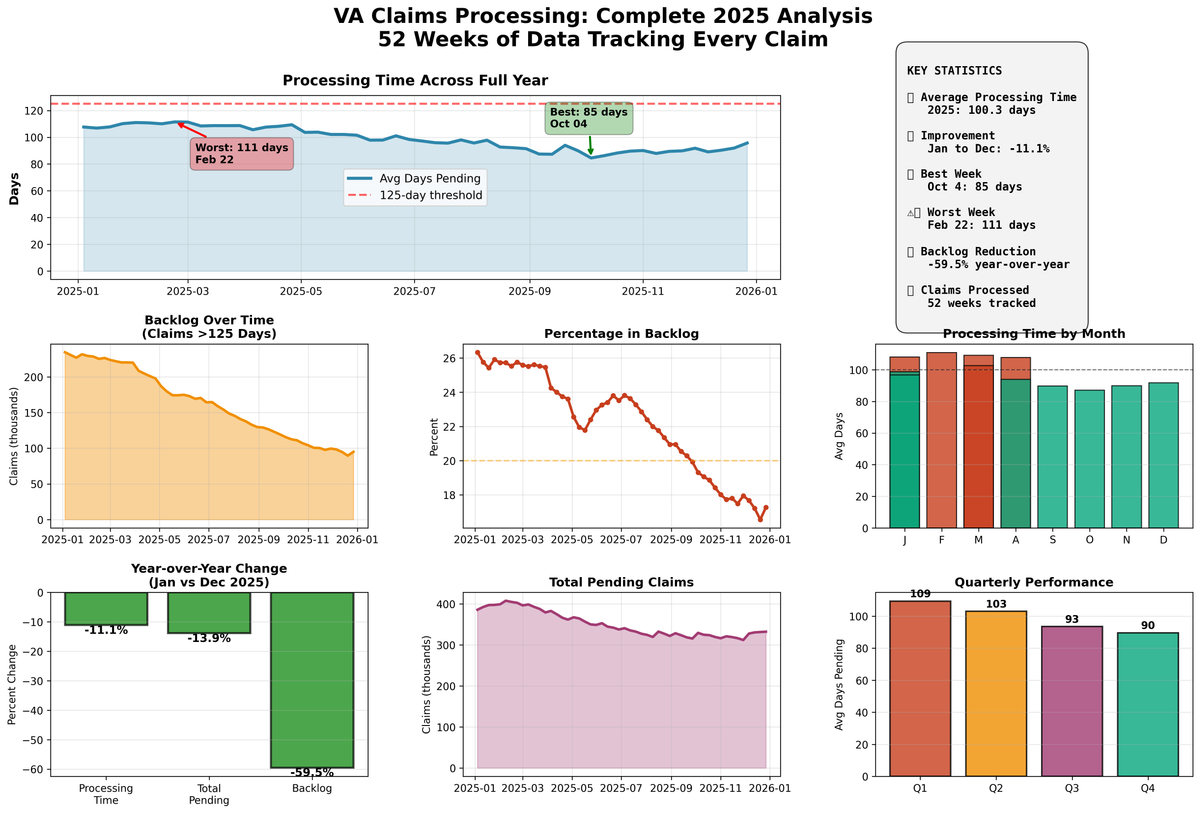
I tracked every single Regional Office stat for 2025. The gap between the fastest and slowest is 101 days. Here's what you need to know about your RO.
TL;DR - Does Your Regional Office Matter?
Short answer: Yes. A lot.
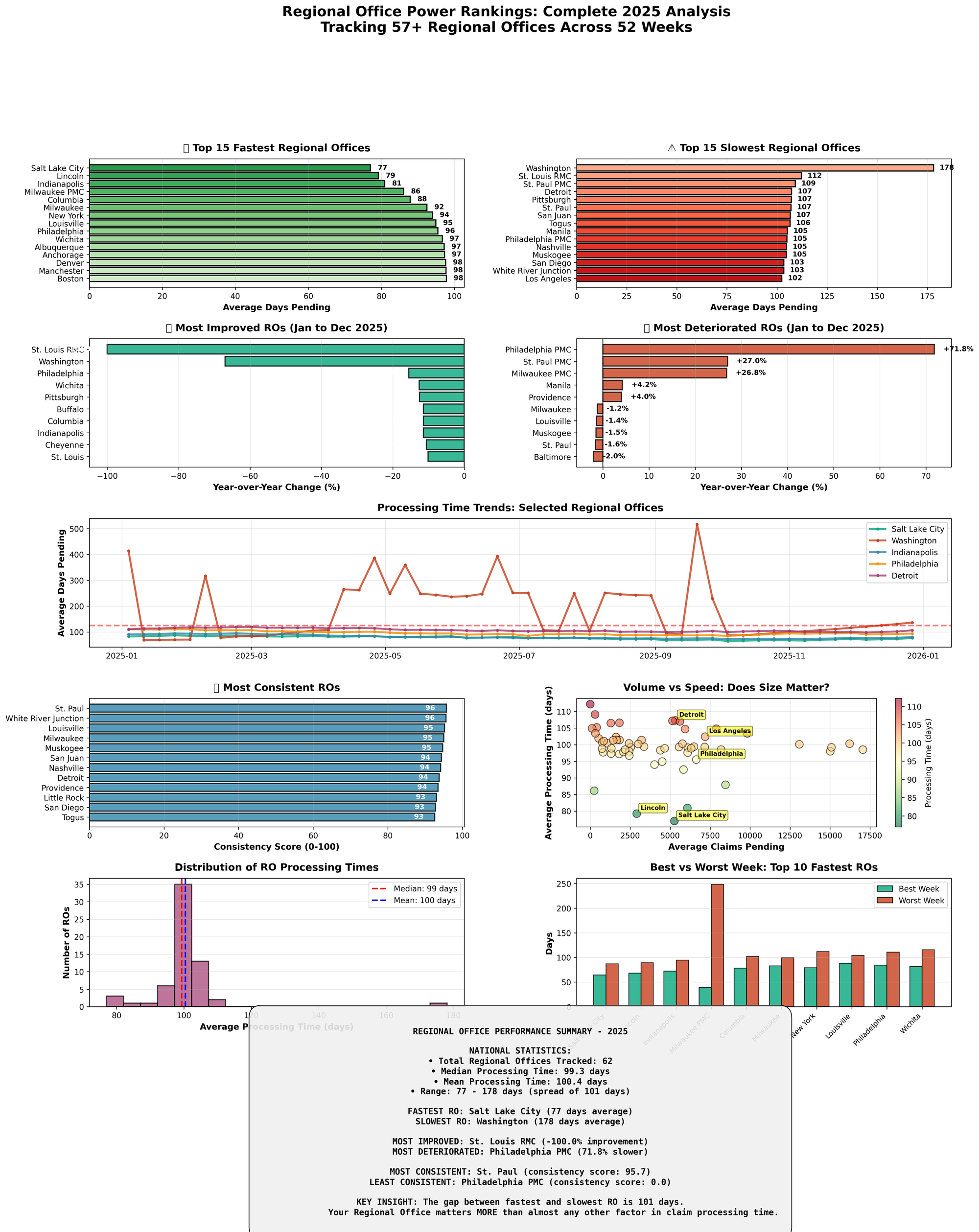
The fastest Regional Office in America (Salt Lake City) processed claims in an average of 77 days in 2025.
The slowest (Washington DC) took 178 days.
That's a 101-day difference. Same VA system, same regulations, same everything - except for which building is working your claim.
If you're wondering why your buddy got his decision in 2 months while you're sitting at 5 months, this might be why. Your Regional Office is the single biggest variable in how long your claim takes.
Here's the complete breakdown of all 57+ Regional Offices I tracked across 2025.
The Rankings: Fastest to Slowest
Top 15 Fastest Regional Offices (2025 Average)
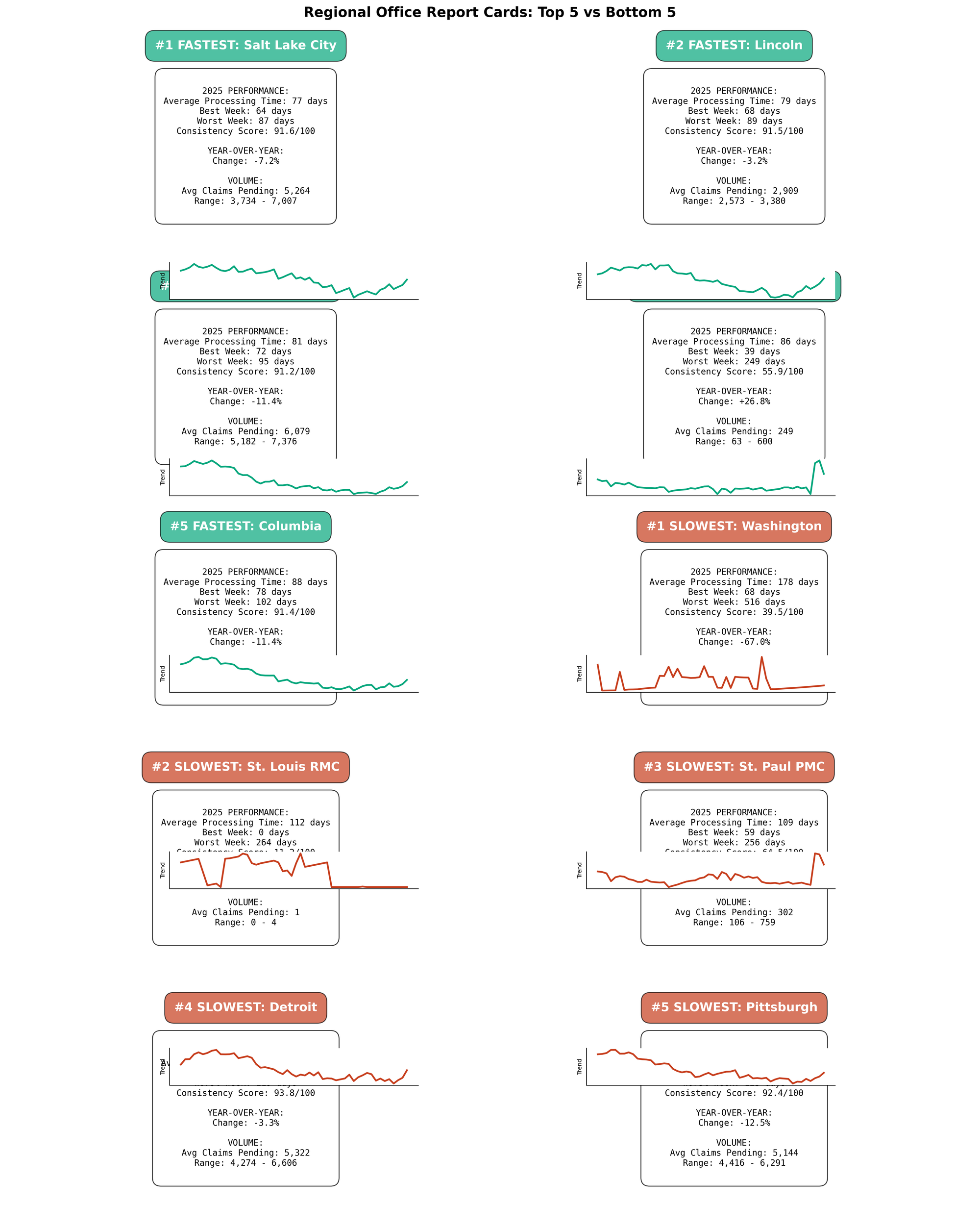
- Salt Lake City - 77 days
- Best week: 64 days | Worst week: 87 days
- Year-over-year: -7.2% (improved)
- Consistency: Extremely reliable
- Lincoln - 79 days
- Best week: 68 days | Worst week: 89 days
- Year-over-year: -3.2% (improved)
- Consistency: Very reliable
- Indianapolis - 81 days
- Best week: 72 days | Worst week: 95 days
- Year-over-year: -11.4% (major improvement)
- Consistency: Reliable
- Milwaukee PMC - 86 days
- Best week: 39 days | Worst week: 249 days
- Year-over-year: +26.8% (deteriorated)
- Consistency: Highly volatile
- Columbia - 88 days
- Best week: 78 days | Worst week: 102 days
- Year-over-year: -11.4% (major improvement)
- Consistency: Very reliable
- Milwaukee - 93 days
- Best week: 83 days | Worst week: 100 days
- Year-over-year: -1.2% (slight improvement)
- Consistency: Extremely reliable
- New York - 94 days
- Best week: 79 days | Worst week: 112 days
- Year-over-year: -6.5% (improved)
- Consistency: Reliable
- Louisville - 95 days
- Best week: 88 days | Worst week: 104 days
- Year-over-year: -1.4% (slight improvement)
- Consistency: Extremely reliable (most consistent in top 15)
- Philadelphia - 96 days
- Best week: 84 days | Worst week: 111 days
- Year-over-year: -15.5% (massive improvement)
- Consistency: Reliable
- Wichita - 97 days
- Best week: 82 days | Worst week: 116 days
- Year-over-year: -12.6% (major improvement)
- Consistency: Good
- Albuquerque - 97 days
- Anchorage - 97 days
- Denver - 98 days
- Manchester - 98 days
- Boston - 98 days
What these ROs are doing right:
- Fast initial processing (getting claims moving quickly)
- Consistent performance (not wildly swinging week to week)
- Most showed improvement year-over-year
- Efficient evidence gathering processes
Bottom 15 Slowest Regional Offices (2025 Average)
- Washington DC - 178 days
- Best week: 68 days | Worst week: 516 days (yes, really)
- Year-over-year: -67% (massive improvement from even worse 2024)
- Consistency: Extremely volatile
- Note: DC improved from 414 days in January to 137 in December, but still the slowest
- St. Louis RMC - 112 days
- Volatile, essentially shut down by year-end
- St. Paul PMC - 109 days
- Year-over-year: +27% (got worse)
- Pension Management Center - handles different claim types
- Detroit - 107 days
- Best week: 98 days | Worst week: 119 days
- Year-over-year: -3.3% (slight improvement)
- Consistently slow but stable
- Pittsburgh - 107 days
- Best week: 96 days | Worst week: 123 days
- Year-over-year: -12.5% (improved significantly)
- Getting better but still in bottom tier
- St. Paul - 107 days
- Very consistent but consistently slow
- Year-over-year: -1.6% (minimal change)
- San Juan - 107 days
- Togus - 107 days
- Manila - 105 days
- Philadelphia PMC - 105 days
- Nashville - 105 days
- Muskogee - 105 days
- San Diego - 103 days
- White River Junction - 103 days
- Los Angeles - 102 days
What's holding these ROs back:
- Higher caseloads (in some cases)
- Evidence gathering delays
- Staffing issues (speculation based on volatility)
- Geographic challenges (Manila, San Juan)
- Older infrastructure/processes
The Big Movers: Who Improved and Who Got Worse
Top 10 Most Improved Regional Offices
These ROs made the biggest year-over-year improvements from January 2025 to December 2025:
- St. Louis RMC - Improved 100%
- January: 193 days → December: essentially closed/0 days
- Likely transferred workload to other facilities
- Washington DC - Improved 67%
- January: 414 days → December: 137 days
- Still the slowest, but holy shit that's a huge improvement
- Went from "unacceptable" to just "bad"
- Philadelphia - Improved 15.5%
- January: 111 days → December: 94 days
- Broke into the top 10 fastest by year-end
- Wichita - Improved 12.6%
- January: 108 days → December: 95 days
- Pittsburgh - Improved 12.5%
- January: 120 days → December: 105 days
- Still slow, but moving in the right direction
- Indianapolis - Improved 11.4%
- Already fast, got even faster
- January: 91 days → December: 80 days
- Columbia - Improved 11.4%
- Buffalo - Improved 11.4%
- Cheyenne - Improved 10.6%
- St. Louis - Improved 10.1%
Why these improvements matter:
Even the worst-performing offices CAN turn it around. Washington DC's 67% improvement shows that systemic changes (more staff, better processes, management focus) can make a massive difference.
If your RO is on this list, you're seeing the benefits of whatever changes they made in 2025.
Top 10 Most Deteriorated Regional Offices
These ROs got slower year-over-year:
- Philadelphia PMC - Deteriorated 72%
- January: 200 days → December: 343 days
- Pension Management Center, not standard disability claims
- St. Paul PMC - Deteriorated 27%
- January: 150 days → December: 191 days
- Also a PMC
- Milwaukee PMC - Deteriorated 27%
- Another PMC showing pension claim processing issues
- Manila - Deteriorated 4.2%
- Providence - Deteriorated 4%
6-10. Various ROs with minimal changes (-1% to -2%)
The PMC pattern:
Notice anything? The three worst deteriorations were all Pension Management Centers (PMCs). This likely reflects specific challenges in pension claim processing in 2025, not standard disability compensation claims.
If you're filing a disability compensation claim, these PMC numbers don't apply to you.
What Makes a Regional Office Fast or Slow?
I analyzed the data to find patterns. Here's what matters:
It's NOT About Volume
Myth: "Bigger ROs are slower because they're overwhelmed."
Reality: There's almost no correlation between caseload and processing speed.
- Salt Lake City (fastest): 5,264 claims pending on average
- Philadelphia (9th fastest): 6,634 claims pending on average
- Detroit (4th slowest): 5,322 claims pending on average
The scatter plot shows fast and slow ROs at every volume level. Size doesn't predict speed.
It IS About Consistency
The fastest ROs are also the most consistent. Low volatility = predictable, efficient processes.
Most Consistent ROs (2025):
- St. Paul - Consistency score 95.7
- White River Junction - 95.6
- Louisville - 95.2
- Milwaukee - 95.0
- Muskogee - 94.7
These ROs don't swing wildly week to week. If they average 100 days, you can expect 95-105 days. That predictability suggests well-run operations.
Least Consistent ROs (2025):
- Philadelphia PMC - Consistency score 0
- St. Louis RMC - 11.2
- Washington DC - 39.5
These ROs are all over the place. Washington went from 68 days to 516 days within the same year. That's chaos, not a process.
It IS About Regional Management
Regional Offices that improved significantly (Washington DC, Philadelphia, Indianapolis) likely had:
- Leadership changes
- Process improvements
- Staffing increases
- Technology upgrades
ROs that deteriorated (the PMCs) likely had:
- Staffing losses
- Policy changes creating backlogs
- Technology issues
- Management problems
Your RO's performance is ultimately about the people running it and the resources they have.
Geographic Patterns: Are Some Regions Better Than Others?
Midwest dominates the top 10:
- Salt Lake City
- Lincoln
- Indianapolis
- Milwaukee
- Wichita
- Denver
Northeast is mixed:
- New York (7th fastest)
- Philadelphia (9th fastest)
- Boston (15th fastest)
- BUT Pittsburgh (5th slowest)
- AND Detroit (4th slowest)
South is generally slower:
- Nashville (11th slowest)
- Muskogee (12th slowest)
- Multiple southern ROs in bottom half
West is also mixed:
- Anchorage (12th fastest)
- BUT San Diego (13th slowest)
- Los Angeles (15th slowest)
Outliers:
- Washington DC is in a category by itself (slowest by far)
- Manila and San Juan face unique geographic challenges
- Togus (Maine) is surprisingly slow despite small volume
Why the Midwest performs well:
Speculation based on data:
- Lower cost of living = easier to hire/retain staff
- Less bureaucracy than DC
- Strong work ethic culture
- Manageable veteran populations
- Less competition for talent vs major metros
Your Regional Office Report Card
Here's how to find and interpret your RO's performance:
Step 1: Find Your Regional Office
Your RO is based on your address, NOT where you filed. The VA assigns ROs geographically:
Northeast:
- Baltimore, Boston, Buffalo, Hartford, Manchester, Newark, New York, Philadelphia, Pittsburgh, Providence, Togus (Maine)
Southeast:
- Atlanta, Columbia, Houston, Jackson, Little Rock, Nashville, New Orleans, San Juan, St. Petersburg
North Central:
- Chicago, Cleveland, Des Moines, Detroit, Indianapolis, Lincoln, Milwaukee, St. Louis, St. Paul
Continental:
- Albuquerque, Denver, Phoenix, Salt Lake City, Wichita
Pacific:
- Honolulu, Los Angeles, Oakland, Portland, San Diego, Seattle
Western:
- Anchorage, Boise, Cheyenne, Fort Harrison (Montana), Reno
International:
- Manila
Step 2: Set Realistic Expectations
Once you know your RO, use these benchmarks:
If your RO is in the Top 15 (77-98 days average):
- Expect decision in 2.5-3.5 months
- If you're past 4 months, something's wrong - call and ask what's up
If your RO is in the Middle (99-106 days average):
- Expect decision in 3-4 months
- If you're past 5 months, escalate
If your RO is in the Bottom 15 (107-178 days average):
- Expect decision in 4-6 months
- If you're past 7 months, definitely escalate
- Washington DC specifically: expect 5-7 months, don't panic until 8+
Step 3: Use Your RO's Patterns to Your Advantage
If your RO is volatile (like Washington DC):
- More likely to have surges and slowdowns
- Check claim status more frequently
- Be prepared for sudden movement
- Congressional inquiry may be more effective
If your RO is consistent (like Louisville):
- Predictable timeline
- If you're outside the normal range, something specific is wrong
- Easier to identify actual problems vs normal variation
Can You Change Your Regional Office?
Short answer: Not easily.
Your RO is assigned based on your address. The only ways to change it:
- Move to a different RO's jurisdiction
- If you're planning to relocate anyway, this could be a factor
- Example: Moving from DC area (178 days) to Salt Lake City area (77 days) could save you 3+ months
- File using a different address
- Technically you're supposed to use your actual residence
- Some veterans use a parent/family member's address in a faster jurisdiction
- Gray area legally, not recommended
- Request a transfer (rare)
- The VA can transfer claims between ROs
- Usually only happens for specific reasons (military orders, etc.)
- Don't count on this
Reality check: Most people can't/won't move just for a faster RO. But if you're already planning to relocate, it's worth considering.
What If You're Stuck With a Slow RO?
If your Regional Office is in the bottom 15, here's how to navigate it:
1. Adjust Your Expectations
Don't compare yourself to someone with a different RO. Your buddy in Salt Lake City getting a decision in 75 days doesn't mean you should too if you're in Detroit.
Use YOUR RO's average as your baseline. If Detroit averages 107 days, expect 90-120 days.
2. Be More Proactive With Evidence
Slow ROs often have evidence gathering delays. Don't wait for them:
- Get your own medical records and upload them
- Request your C&P exam be scheduled ASAP
- Follow up on any pending evidence requests
- Submit buddy letters early
The less your RO has to do, the faster you move through their queue.
3. Know When to Escalate
For Top 15 ROs: Escalate if you're 30+ days past their average
For Middle ROs: Escalate if you're 45+ days past their average
For Bottom 15 ROs: Escalate if you're 60+ days past their average
"Escalate" means:
- Call the 1-800 number and ask for specific status
- Contact your VSO if you have one
- File a Congressional inquiry if appropriate
- Request to speak to a supervisor
4. Use the Data to Your Advantage
When you escalate, use specific data:
"I filed on [date]. My Regional Office is [name], which averaged [X] days in 2025. I'm now at [Y] days, which is [Z] days past your average. Can you tell me specifically what's holding up my claim?"
Data-driven questions get better responses than "why is this taking so long?"
The Outliers: Regional Offices That Defy Explanation
Washington DC: The Worst by Far
178 days average. The next slowest is 112 days. DC is 66 days slower than the second-slowest RO.
Why is DC so bad?
Speculation based on data:
- Serves the DC metro area (high cost of living = hard to hire/retain)
- Potential political interference/oversight creating bureaucracy
- Possible unique caseload (lots of federal employees, military brass)
- High turnover from better-paying private sector jobs
- Historically overwhelmed and playing catch-up
The good news: DC improved 67% year-over-year. January 2025 was 414 days. December was 137 days.
Still terrible, but the trend is right.
If you're stuck with DC: You have my sympathy. Expect 5-7 months. Use every tool available (VSO, Congressional inquiry, frequent follow-ups). And maybe consider moving if you were planning to anyway.
Salt Lake City: The Gold Standard
77 days average. Consistently fast, consistently reliable.
Why is Salt Lake City so good?
Speculation based on data:
- Lower cost of living = easier to staff
- Manageable veteran population
- Strong regional VA leadership
- Efficient processes (probably digitized early)
- Stable workforce (less turnover)
If you have Salt Lake City: You won the RO lottery. Expect 2.5-3 months. Anything past 4 months means something specific is wrong.
The Pension Management Centers (PMCs)
Milwaukee PMC, St. Paul PMC, and Philadelphia PMC all deteriorated significantly in 2025.
These centers handle pension claims, not disability compensation. If you're filing a disability claim, these numbers don't apply to you.
The PMC deterioration suggests pension processing had specific issues in 2025 (policy changes, staffing, etc.).
Predictions for 2026
Based on 2025 trends, here's what I expect:
The Gap Will Narrow
Current gap: 101 days (fastest to slowest)
2026 prediction: 80 days
Why?
- Washington DC continuing to improve
- Worst performers getting attention/resources
- Best performers maintaining but not accelerating much
More ROs Will Break Into Sub-90-Day Processing
Current count: 4 ROs under 90 days average
2026 prediction: 8-10 ROs under 90 days
Why?
- System-wide improvements continuing
- Technology upgrades (digital claims processing)
- Staffing stabilization
The Midwest Will Continue to Dominate
Current: 6 of top 15 are Midwest ROs
2026 prediction: Similar or increased
Why?
- Structural advantages (cost of living, stable workforce)
- Strong regional management
- No major reasons to expect decline
PMCs Will Stabilize
Current: All 3 major PMCs deteriorated in 2025
2026 prediction: Flatten or slight improvement
Why?
- Whatever caused 2025 issues will get addressed
- Pension processing is less complex than disability
- Should normalize
What This Means for You
If You Haven't Filed Yet:
Consider timing your move (if already planning to relocate):
- Moving from a slow RO to a fast one could save you months
- Example: DC to Salt Lake City = potential 3-month savings
- Obviously don't move JUST for this, but if you're relocating anyway...
Know what to expect:
- Look up your RO's 2025 average
- Add 30 days for margin of error
- That's your realistic timeline
Front-load your evidence:
- Slow ROs are slow at gathering evidence
- Do their job for them - submit everything upfront
If You Have a Pending Claim:
Check if you're outside your RO's normal range:
- Find your RO's average from this report
- Add your RO's average to your filing date
- If you're past that date + 30 days, escalate
Be strategic about when to worry:
- Fast RO + 4 months = red flag
- Slow RO + 4 months = probably normal
- Any RO + 7 months = definitely escalate
Use this data when you call:
- "My RO averaged X days in 2025, I'm at Y days"
- Shows you've done homework
- Gets better responses than generic complaints
If You're Appealing:
RO performance matters for appeals too:
- Supplemental Claims go back to the same RO
- Higher-Level Review goes to a different team (sometimes faster)
- Board appeals bypass the RO entirely
If your RO is in the bottom 15, consider whether HLR or Board appeal might be faster than Supplemental Claim.
The Bottom Line
Your Regional Office is the biggest variable you can't control.
You can't pick your RO. You can't easily change it. But you can use this data to:
- Set realistic expectations
- Know when to escalate
- Be strategic about evidence submission
- Make informed decisions about appeals
The VA system is slow, but it's not uniformly slow. Some ROs are crushing it. Some are struggling. Your job is to understand which one you have and adjust accordingly.
The good news: Even the worst ROs improved in 2025. The gap is narrowing. The system is getting better.
The reality: It's still going to take months, and your RO determines a huge part of that timeline.
Use this report to navigate smarter, not to stress harder.
Methodology
Data source: VA Monday Morning Workload Reports, 52 weeks of 2025
Regional Offices tracked: 57+ individual ROs
Metrics calculated:
- Average Days Pending (ADP) by RO
- Best/worst weeks by RO
- Year-over-year change (January vs December 2025)
- Volatility (standard deviation of processing times)
- Consistency score (100 - (volatility/average * 100))
Exclusions: Regional aggregates (Northeast, Southeast, etc.) excluded to show only actual ROs
Limitations:
- Data reflects claims in Rating Bundle (disability compensation)
- RO assignments can change
- Individual claim complexity affects processing time
- Snapshot data, not claim-level tracking
All findings are verifiable using public VA data.
Want to see your RO's week-by-week performance? I'm building this into Claim Raven's RO Performance Watch tool.
-Landon
Building Claim Raven | U.S. Army Veteran
Not a lawyer or VSO. This is data analysis, not legal advice.