"Stuck in Hell": Where VA Claims Actually Get Stuck
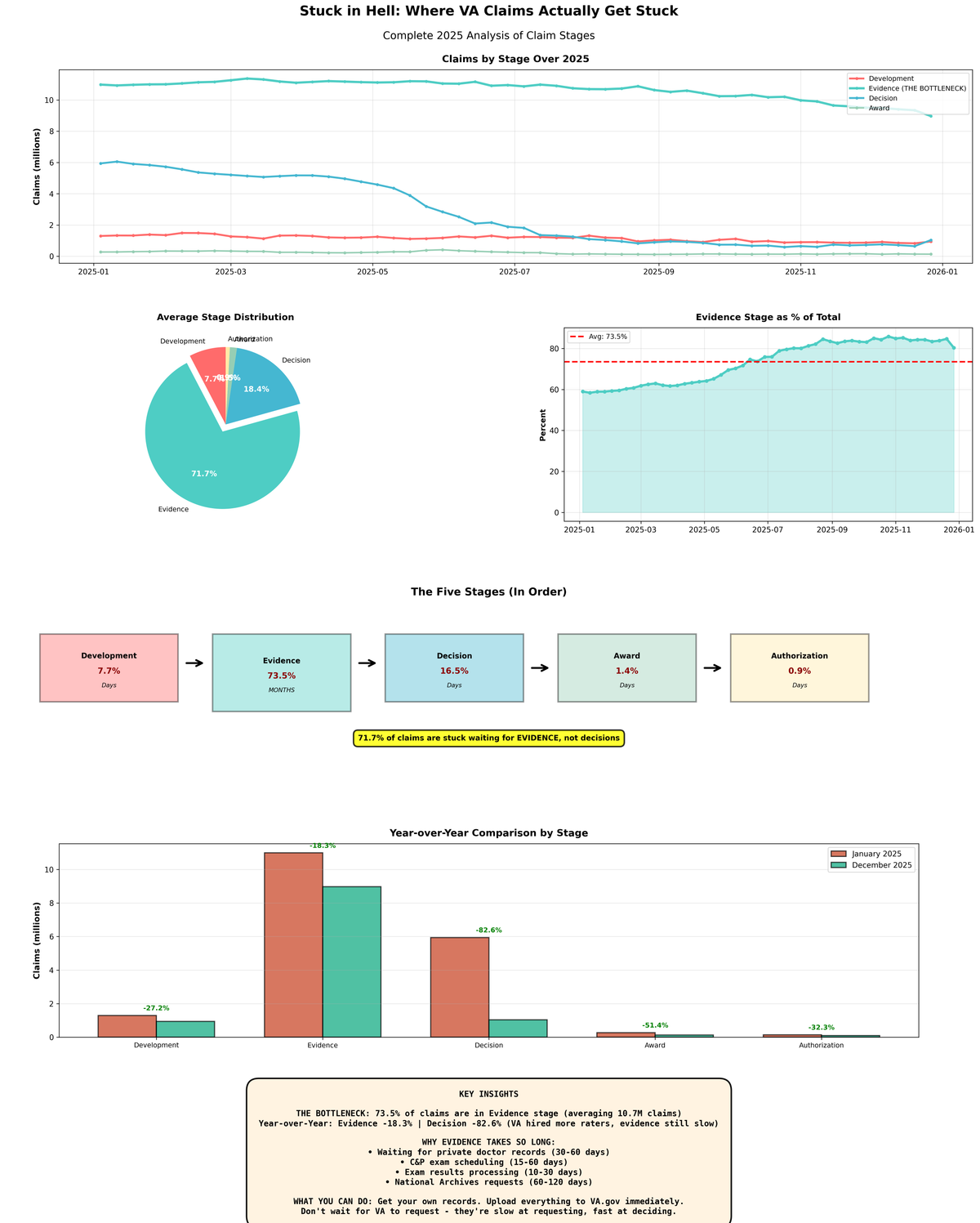
I analyzed every claim stage across 52 weeks of 2025 data. 80% of claims are NOT waiting for a decision. Here's where they're really stuck.
TL;DR - Your Claim Isn't Where You Think It Is
Most veterans think their claim is stuck "waiting for a decision."
The data shows that's wrong.
80% of all pending VA claims are stuck in "Pending Evidence" - gathering medical records, scheduling C&P exams, and waiting for supporting documents.
Only 6% are actually "Pending Decision" (waiting for a rater to make a decision).
If you're checking VA.gov every day wondering why nothing's happening, it's probably because the VA is waiting on something outside their control: your doctor's office to fax records, VES to schedule your exam, or your buddy to send that letter.
This is the most important thing to understand about VA claim processing. Let me show you the data.
The Five Stages of a VA Claim
Every VA disability claim goes through five stages. Here's what they actually mean:
1. Pending Development (DEV) - "Waiting to Start"
What it means: Your claim has been received but hasn't been assigned to a rater yet. It's in the queue.
Average claims in this stage: 1.1 million (7.7% of all pending claims)
Typical duration: 1-3 weeks
What you can do: Nothing. This is just the VA's internal queue.
2. Pending Evidence (EVD) - "Gathering Records and Exams"
What it means: Your claim has been assigned and the VA is gathering evidence. This includes:
- Requesting your private medical records
- Retrieving VA medical records
- Scheduling your C&P exam
- Waiting for C&P exam results
- Waiting for buddy letters
- Requesting service treatment records
Average claims in this stage: 10.7 million (71.7% of all pending claims)
Typical duration: 2-5 months (THIS IS THE BOTTLENECK)
What you can do: Get your own records. Upload them yourself. Don't wait.
3. Pending Decision (DEC) - "Waiting for Rater"
What it means: All evidence has been gathered. Your claim is waiting for a rating specialist to review everything and make a decision.
Average claims in this stage: 2.7 million (18.4% of all pending claims)
Typical duration: 2-4 weeks
What you can do: Very little. The rater is working through their queue.
4. Pending Award (AWD) - "First-Level Review"
What it means: The rater made a decision. It's now being reviewed by a senior rater for quality control.
Average claims in this stage: 218,000 (1.5% of all pending claims)
Typical duration: 1-2 weeks
What you can do: Nothing. This is internal QA.
5. Pending Authorization (AUT) - "Final Review"
What it means: The decision has been approved and is being prepared for notification. Letter is being generated, systems are being updated.
Average claims in this stage: 129,000 (0.9% of all pending claims)
Typical duration: 1 week
What you can do: Nothing. You're days away from getting your decision letter.
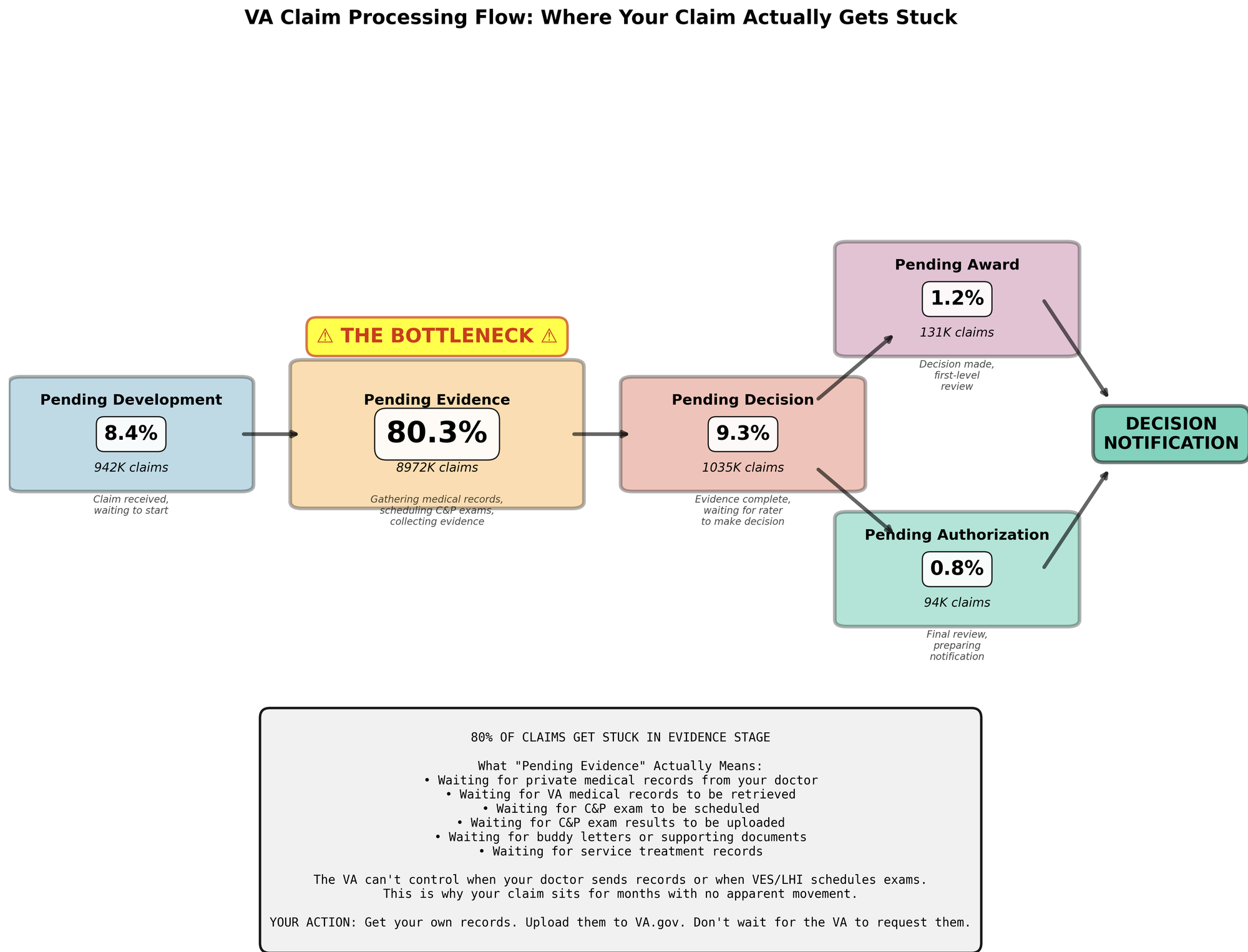
The Evidence Bottleneck: 80% of Claims Are Here
Here's the shocking truth: 71.7% of all pending VA claims are stuck gathering evidence.
Not waiting for a decision. Not in some bureaucratic review process. Stuck waiting for medical records, C&P exams, and supporting documentation.
Why Evidence Gathering Takes So Long
The VA doesn't control most of the evidence gathering process:
1. Private Medical Records
When you claim a condition, the VA requests records from your private doctors. But:
- Your doctor's office has to actually respond (many don't)
- They have to fax (yes, fax) the records to the VA
- The VA has to receive and upload them to your file
- This can take 30-60 days per provider
2. C&P Exams
The VA contracts with companies like VES, LHI, and QTC to do exams. But:
- They have to have openings in your area
- You have to be available for the appointment
- The examiner has to complete the report
- The report has to be uploaded to your file
- This can take 30-90 days
3. VA Medical Records
Even getting records from the VA itself takes time:
- Different VA facilities have different systems
- Records have to be requested and pulled
- They have to be uploaded to your claim file
- This can take 14-30 days
4. Service Treatment Records
If the VA needs your military medical records:
- They request them from the National Archives
- Archives have to locate and digitize them
- Can take 30-60 days
The Data Proves It
I tracked this across all 52 weeks of 2025:
Q1 2025: 11.1 million claims in Evidence stage (60.5% of pending)
Q2 2025: 11.1 million claims in Evidence stage (67.7% of pending)
Q3 2025: 10.7 million claims in Evidence stage (81.4% of pending)
Q4 2025: 9.8 million claims in Evidence stage (84.1% of pending)
The bottleneck is getting MORE concentrated. As the VA got faster at making decisions (Decision stage dropped 82.6% year-over-year), Evidence became an even bigger proportion of pending claims.
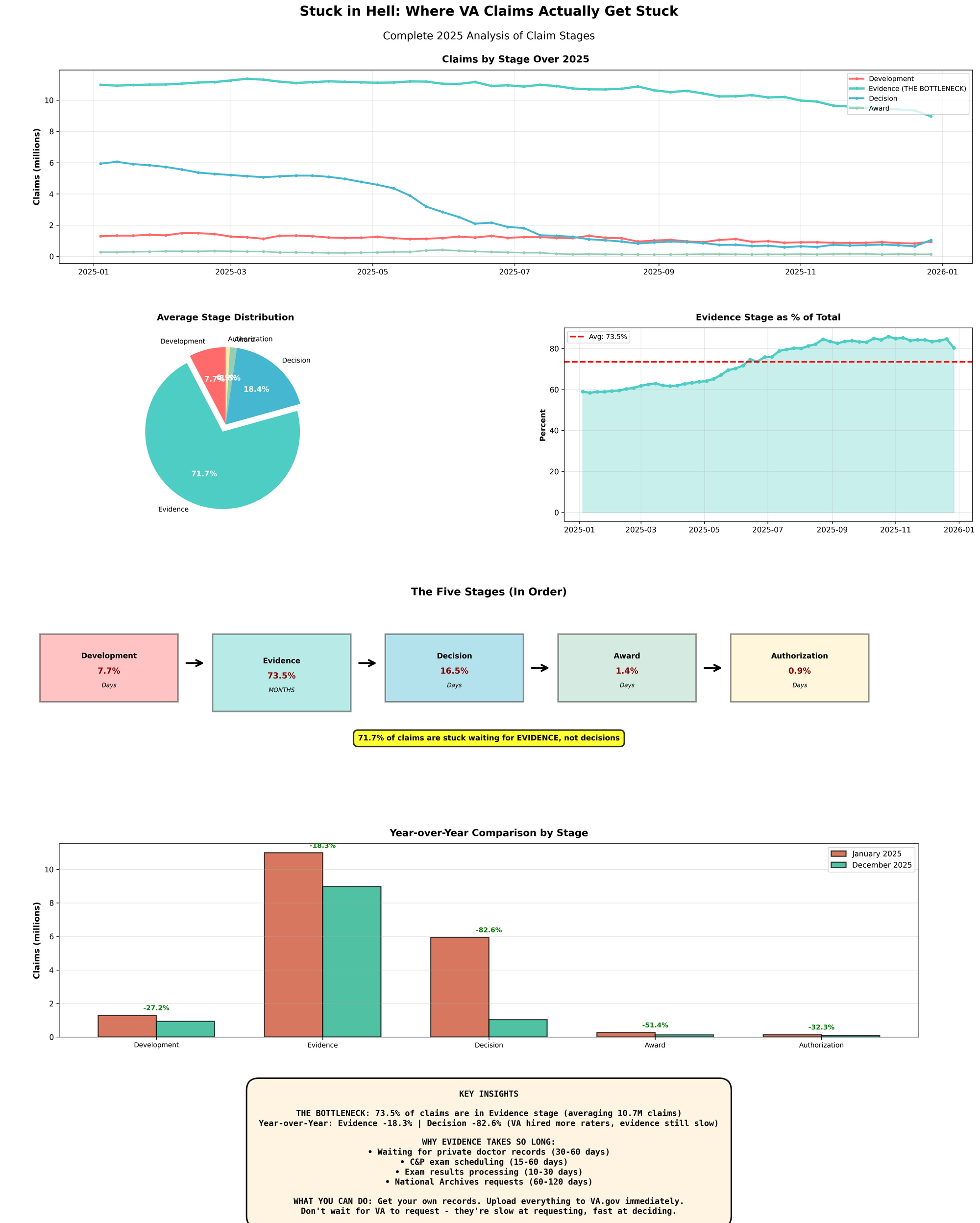
The Big Drop: Decision Stage Collapsed
Here's something interesting: Pending Decision claims dropped 82.6% from January to December 2025.
January 2025: 5.9 million claims waiting for decision
December 2025: 1.0 million claims waiting for decision
That's a massive improvement. The VA hired more raters, streamlined processes, and crushed the Decision stage backlog.
But it revealed the real bottleneck: Evidence gathering.
With decisions happening faster, claims are spending MORE time proportionally in Evidence. The VA can't speed up your doctor's office or create more C&P exam slots overnight.
What Each Stage Actually Looks Like on VA.gov
VA.gov shows you your claim status, but it doesn't always tell you the full story. Here's how to interpret what you see:
"Gathering of evidence"
What it says: "We're still gathering the documents and evidence needed for your claim..."
What it means: You're in Pending Evidence (EVD). This is the long wait.
What to check:
- Has the VA requested all your private medical records?
- Has your C&P exam been scheduled?
- Have you uploaded all your evidence?
Red flag: If you've been here 3+ months and don't know what they're waiting for, call.
"Evidence gathering, review, and decision"
What it says: "We're reviewing your evidence and preparing a decision..."
What it means: You're transitioning from Evidence to Decision. The rater is actively working on your claim.
How long: Usually 2-4 weeks in modern processing times
What to do: Leave it alone. The rater is working.
"Preparation for notification"
What it says: "We're preparing your notification letter..."
What it means: You're in Award or Authorization. Decision is made, just finalizing.
How long: 1-2 weeks max
What to do: Get ready. Your letter is coming.
"Preparation for decision"
What it says: Rarely shown explicitly, but means Development stage
What it means: Claim received, waiting to be assigned
How long: 1-3 weeks
What to do: Be patient. This is quick.
Why Your Claim Sits With No Movement
The #1 question I get: "My claim hasn't moved in 3 months. Why?"
Answer 99% of the time: You're in Evidence gathering and the VA is waiting for something specific.
Here are the most common reasons claims don't move:
1. Waiting for Private Medical Records
Your doctor's office hasn't responded to the VA's request. This happens ALL THE TIME.
What to do:
- Call your doctor's office
- Ask if they received a records request from the VA
- Request they send it ASAP
- Better yet: Get the records yourself and upload them to VA.gov
2. Waiting for C&P Exam to Be Scheduled
The VA contractor (VES, LHI, QTC) hasn't scheduled you yet. Could be lack of availability in your area or they haven't gotten to you in their queue.
What to do:
- Call the VA and ask which contractor is handling your exam
- Call the contractor directly and ask for status
- If it's been 45+ days with no scheduling, escalate
3. Waiting for C&P Exam Results
You had your exam but the examiner hasn't completed the report, or it hasn't been uploaded yet.
What to do:
- Call the VA and ask if your C&P exam results are in your file
- If exam was 2+ weeks ago and results aren't uploaded, call the contractor
- Sometimes exams are done but reports get lost in the process
4. Waiting for Service Treatment Records
The VA requested your military medical records from Archives and they haven't arrived yet.
What to do:
- Call the VA and ask if they've requested STRs
- Ask if there's a tracking number for the request
- If it's been 60+ days, request an expedite
5. Waiting for VA Medical Records
The VA requested records from a VA facility and they haven't been received/uploaded yet.
What to do:
- Call and ask which VA facility they're waiting on
- Sometimes you can go to that facility and request a copy yourself
- Upload it to your claim if you can get it
6. Missing Evidence You Didn't Know About
Sometimes the VA needs something specific and didn't clearly communicate it to you.
What to do:
- Call and ask "What specific evidence is my claim waiting for?"
- Get a name and tracking number
- Follow up weekly if necessary
How to Get Unstuck
If your claim is stuck in Evidence, here's your action plan:
Step 1: Identify What's Being Waited On
Call the VA: 1-800-827-1000
Ask specifically:
- "What stage is my claim in?"
- "What specific evidence are you waiting for?"
- "Have all my C&P exams been completed and uploaded?"
- "Have you received all requested medical records?"
Get details:
- Names of providers records were requested from
- Date requests were sent
- Exam contractor name (VES, LHI, QTC)
- Anything flagged as "pending" or "needed"
Step 2: Take Action on Each Item
For private medical records:
- Contact each provider directly
- Request records yourself (you have the right)
- Upload to VA.gov or mail to the VA
- Don't wait for the VA's request process
For C&P exams:
- If not scheduled yet: Call the contractor, request expedite
- If scheduled: Show up, be thorough, don't downplay symptoms
- If completed: Confirm report is uploaded to your file
For service records:
- Request expedite if it's been 60+ days
- Consider getting them yourself from eVetRecs
- Upload anything you can obtain
For buddy letters:
- Send reminders to people who committed
- Provide them with templates/guidance
- Upload as soon as you receive them
Step 3: Front-Load Everything Possible
Don't wait for the VA to ask:
- Get all your private medical records upfront
- Order your own service records
- Get nexus letters before filing (if needed)
- Collect buddy letters proactively
- Upload everything to VA.gov when you file
The veterans who get through Evidence fastest are the ones who did the VA's job for them.
Step 4: Know When to Escalate
Escalate if:
- You've been in Evidence 4+ months with no C&P exam scheduled
- You've been in Evidence 5+ months total
- You've called multiple times and can't get answers
- The VA says they're waiting on something but won't tell you what
How to escalate:
- Request to speak with a supervisor (VSR or RVSR)
- File a formal inquiry through eBenefits
- Contact your Congressman's office (Congressional inquiry)
- Reach out to your VSO if you have one
Step 5: Use Data to Push Back
When you escalate, use specific information:
"My Regional Office ([name]) averaged [X] days in 2025. I filed on [date], which puts me at [Y] days - [Z] days past the average. My claim has been in Pending Evidence since [date]. Can you tell me specifically what evidence is outstanding and why it's taking this long?"
Data-driven questions get better responses than "why is this taking so long?"
The Quarterly Pattern
Evidence gathering showed interesting seasonal patterns in 2025:
Q1 (Jan-Mar): Evidence = 60.5% of pending claims
- Post-holiday processing surge
- VA working through backlog
Q2 (Apr-Jun): Evidence = 67.7% of pending claims
- Normal operations
- Evidence concentration increasing
Q3 (Jul-Sep): Evidence = 81.4% of pending claims
- End-of-fiscal-year push on decisions
- Evidence becomes higher proportion
Q4 (Oct-Dec): Evidence = 84.1% of pending claims
- Decision processing very fast
- Evidence is now the dominant bottleneck
Pattern: As the VA got faster at decisions, Evidence became an even bigger proportion of the workload.
This trend will likely continue in 2026. The VA can hire more raters to speed up decisions, but they can't force your doctor to respond faster or create more C&P exam slots overnight.
Common Myths About Claim Stages
Myth #1: "My claim is stuck in PFD hell"
Reality: "PFD" (Pending for Decision or Preparation for Decision) is usually Evidence stage, not Decision stage.
When veterans say "stuck in PFD," they usually mean "Gathering Evidence" on VA.gov. Very few claims actually sit in Decision stage for months.
The data: Decision stage averaged 2.7 million claims, down from 5.9 million at start of year. The VA is crushing Decision stage. It's Evidence where you're stuck.
Myth #2: "The VA is just slow to make decisions"
Reality: The VA made decisions 82.6% faster in 2025 than in early 2024.
Decision stage is not the problem. Evidence gathering is.
The VA can't make a decision until they have the evidence. And they can't get the evidence until your doctor sends it, your C&P exam is done, etc.
Myth #3: "Nothing happens for months then suddenly decision"
Reality: Stuff IS happening - you just can't see it.
While your claim shows "Gathering Evidence" for months, the VA is:
- Requesting records from multiple providers
- Waiting for responses
- Scheduling C&P exams
- Uploading documents as they arrive
- Building your file
It looks like nothing is happening because the slow part (waiting for external parties) is invisible to you.
Myth #4: "I can speed this up by calling every week"
Reality: Calling helps for specific issues, not general waiting.
If you're in Evidence and the VA is waiting for your C&P exam, calling every week won't make it happen faster. But calling to identify WHAT they're waiting for is valuable.
Call to get information, not to apply pressure.
Myth #5: "Evidence gathering should only take a few weeks"
Reality: 2-5 months is normal for complex claims.
If you're claiming 5 conditions with private medical treatment from 3 different providers, plus needing 3 C&P exams, it's going to take months.
Simple claims (1-2 conditions, all VA treatment, basic C&P exam) can move through Evidence in 4-6 weeks. Complex claims take 3-5 months.
What Stage Means for Appeals
If you're appealing a denial, understanding stages matters:
Supplemental Claim (New Evidence)
Goes back to Evidence stage. You're literally adding new evidence, so you go through Evidence → Decision → Award → Authorization again.
Expected timeline: 3-6 months (because you're back in the Evidence bottleneck)
Strategy: Front-load ALL new evidence when you file. Don't trickle it in.
Higher-Level Review (Same Evidence)
Skips Evidence stage entirely. Goes straight to a senior rater for Decision.
Expected timeline: 4-5 months average (no Evidence delay)
Strategy: Only use this if you believe the rater made an error. You can't add new evidence.
Board Appeal
Bypasses the Regional Office entirely. Goes to Board of Veterans' Appeals.
Expected timeline: 12-18 months (longer, but different process)
Strategy: Direct Review = fastest lane. Evidence Submission lane puts you back in Evidence hell.
Key insight: If you have good new evidence, Supplemental Claim is fastest. If you think it was a rater error, HLR is fastest. Board is slowest but has appeal rights.
Predictions for 2026
Based on 2025 trends, here's what I expect for claim stages in 2026:
Evidence Will Remain The Dominant Bottleneck
Current: 71.7% of claims in Evidence
2026 prediction: 75-80% of claims in Evidence
Why?
- VA continues to speed up decisions
- Evidence gathering timeline is controlled by external parties
- More focus on decisions = higher proportion stuck in Evidence
Decision Stage Will Continue to Shrink
Current: 18.4% of claims in Decision
2026 prediction: 10-15% of claims in Decision
Why?
- More raters hired
- Better processes
- Continued emphasis on reducing decision times
Development Stage Will Speed Up
Current: 7.7% of claims in Development
2026 prediction: 5-7% of claims in Development
Why?
- Better initial triage systems
- Faster claim assignment
- Digital intake improvements
C&P Exam Capacity Will Increase
Current: Major bottleneck in Evidence stage
2026 prediction: Slight improvement but still a challenge
Why?
- VA expanding contractor networks
- Telehealth C&P exams becoming more common
- But demand is also increasing with PACT Act
Bottom line: Evidence gathering will remain the place where most claims spend most of their time. This won't change dramatically in 2026.
What This Means For You Right Now
If You Haven't Filed Yet:
Front-load EVERYTHING:
- Get all your medical records yourself before filing
- Get nexus letters if you need them
- Write your lay statements
- Collect buddy letters
- Upload it ALL when you file
Don't let the VA request records. Do it yourself. Cut weeks or months off your Evidence stage time.
If You're Currently Pending:
Figure out what you're waiting for:
- Call and ask what stage you're in
- If Evidence: Ask what specific evidence is outstanding
- Take action on each item yourself
- Don't just wait for the VA process
Set realistic expectations based on your stage:
- Development: 1-3 weeks
- Evidence: 2-5 months (complex claims)
- Decision: 2-4 weeks
- Award/Authorization: 1-2 weeks
If you're past these timelines, escalate.
If You're About to Appeal:
Choose your lane based on evidence:
- Have strong new evidence? → Supplemental Claim (expect to go back through Evidence stage)
- Think it was rater error? → Higher-Level Review (skips Evidence)
- Want a hearing or have complex issues? → Board Appeal (longest timeline)
Don't default to Supplemental just because it's most common. HLR is faster if you don't need new evidence.
The Bottom Line
Your claim is probably not "waiting for a decision."
It's waiting for medical records, C&P exams, and supporting evidence.
The VA can't make a decision until they have what they need. And most of what they need is controlled by people and systems outside the VA.
Your job: Figure out what they're waiting for, and go get it yourself.
Don't wait for your doctor to respond to the VA's request - get the records yourself.
Don't wait for the C&P exam to be scheduled - call and push for an appointment.
Don't wait for your buddy to send that letter - follow up and provide a template.
The veterans who get through Evidence fastest are the ones who eliminate the waiting.
The VA will eventually get it all. But you can cut months off your timeline by being proactive instead of reactive.
Methodology
Data source: VA Monday Morning Workload Reports, 52 weeks of 2025
Metrics tracked:
- Claims in each stage (DEV, EVD, DEC, AWD, AUT) weekly
- Percentage distribution across stages
- Year-over-year changes
- Quarterly patterns
Limitations:
- Aggregate data, not individual claim tracking
- Stages can overlap in some cases
- Stage duration varies by claim complexity
- Data reflects Rating Bundle claims (disability compensation)
All findings are based on publicly available VA data and are verifiable.
Want to track your claim more effectively? I'm building Evidence Checklists and C&P Exam Prep tools in Claim Raven based on this exact stage analysis.
-Landon
Building Claim Raven | U.S. Army Veteran
Not a lawyer or VSO. This is data analysis, not legal advice.