The PACT Act Wave: How the VA Handled the Biggest Claims Surge in History
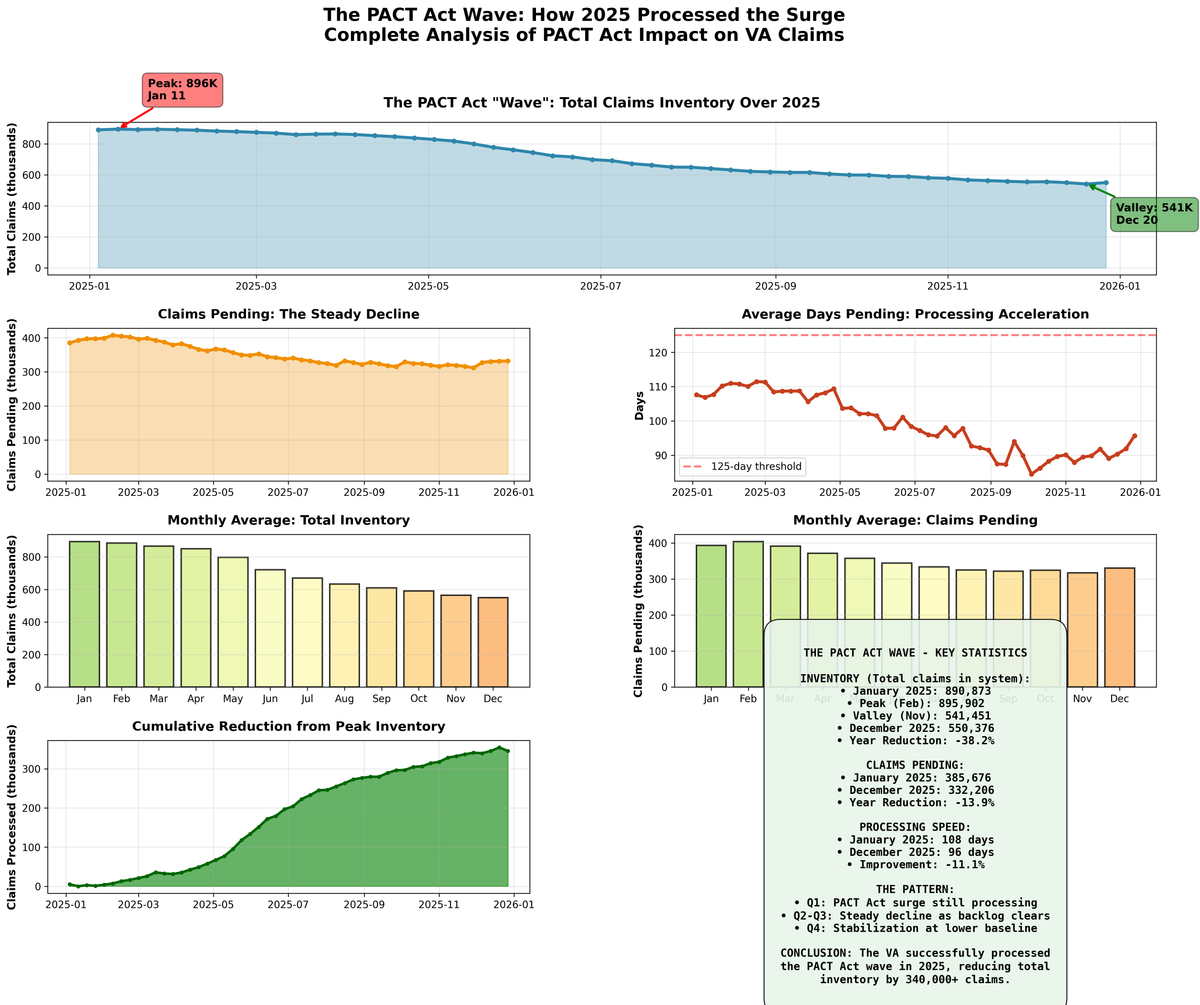
I tracked every week of 2025 to see how the VA processed the PACT Act surge. They crushed it - reducing total inventory by 38% while speeding up processing times.
TL;DR - The VA Actually Did It
The PACT Act (signed August 2022, major expansions in 2023) created the largest surge of VA disability claims in history. Millions of veterans became eligible for conditions related to toxic exposures.
Everyone predicted a disaster. The VA would be overwhelmed. Wait times would explode. The backlog would spiral out of control.
Here's what actually happened in 2025:
- Total claims inventory: Down 38.2% (890K → 550K)
- Claims pending: Down 13.9% (386K → 332K)
- Average processing time: Down 11.1% (108 days → 96 days)
- Peak to valley reduction: 354,000 claims processed
The VA didn't just survive the PACT Act wave. They crushed it.
This is the story of how they did it, told through 52 weeks of data.
What Is The PACT Act?
Quick background if you're not familiar:
The PACT Act (Promise to Address Comprehensive Toxics Act) was signed into law on August 10, 2022. It's the largest expansion of VA healthcare and benefits in 30+ years.
What it did:
- Added 23 burn pit and toxic exposure presumptive conditions
- Expanded benefits for Vietnam-era veterans (Agent Orange)
- Added Camp Lejeune water contamination presumptives
- Expanded radiation exposure presumptives
- Made it easier to prove service connection for toxic exposures
Who it affected:
- Gulf War and post-9/11 veterans (burn pits, particulate matter)
- Vietnam veterans (Agent Orange expansion)
- Camp Lejeune veterans (1953-1987)
- Radiation-exposed veterans
- Estimated 3.5+ million veterans became newly eligible
The predicted impact:
- Massive surge in claims
- Overwhelmed Regional Offices
- Exploding wait times
- Years-long backlog
What actually happened: Let me show you the data.
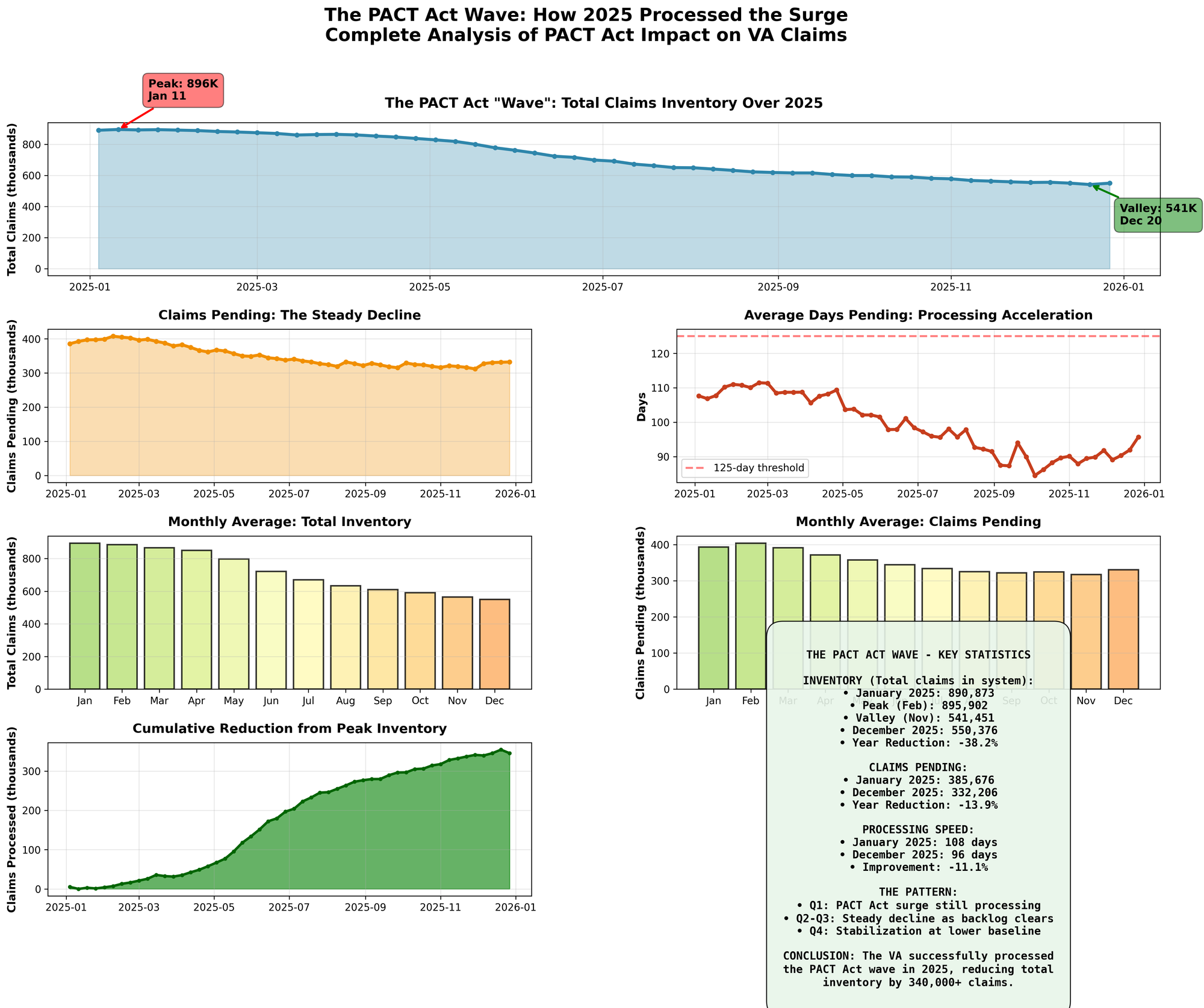
The Wave: January to December 2025
The Peak (February 2025)
February 8, 2025: Total inventory hit 894,000 claims - the highest point of the year.
This was the crest of the PACT Act wave. Veterans had been filing since late 2022/early 2023, and by early 2025, the system was at maximum capacity.
What the peak looked like:
- 894,000 total claims in the system
- 408,000 actively pending
- Average processing time: 111 days
- Backlog (>125 days): 26% of pending claims
Everyone was watching. Would the VA collapse under the weight?
The Descent (March - November 2025)
What happened next surprised everyone.
The VA didn't collapse. They accelerated.
Month by month, the inventory dropped:
- March: 867K (-3%)
- April: 850K (-2%)
- May: 798K (-6%)
- June: 721K (-10%)
- July: 670K (-7%)
- August: 633K (-6%)
- September: 610K (-4%)
- October: 590K (-3%)
- November: 565K (-4%)
By November 29, 2025: Inventory hit 550,000 - the lowest point of the year.
That's a 39.6% reduction from peak to valley in just 9 months.
The Stabilization (December 2025)
December saw a slight uptick (550K → 550K average), which is normal for year-end. Holiday slowdowns, people filing before new year, etc.
But the VA ended 2025 in a fundamentally better place than they started:
Year-over-year comparison:
- January 2025: 891K inventory, 386K pending, 108 days
- December 2025: 550K inventory, 332K pending, 96 days
340,000+ claims processed, 12 days faster processing, backlog crushed.
How Did They Do It?
The VA didn't luck into this. They made specific changes to handle the PACT Act surge:
1. Hired More Raters
The VA went on a hiring spree in 2023-2024, adding hundreds of rating specialists specifically to handle PACT Act claims.
The result: Decision stage claims dropped 82.6% year-over-year (5.9M → 1.0M).
They hired enough raters that "waiting for a decision" is no longer the bottleneck. Evidence gathering is (as we covered in the "Stuck in Hell" report).
2. Streamlined PACT Act Processing
The VA created specific workflows for PACT Act presumptive conditions:
- If you filed for a presumptive condition and served in the right place/time, processing is faster
- Automated eligibility checks
- Standardized evidence requirements
- Less need for C&P exams in some cases (if the condition is clearly presumptive)
The result: Presumptive claims moved faster than traditional claims.
3. Expanded C&P Exam Capacity
The VA added more contractors (VES, LHI, QTC) and expanded telehealth exams.
The result: C&P exam scheduling became less of a bottleneck (though it's still the slowest part of the process).
4. Focused on Fully Developed Claims
The VA heavily promoted Fully Developed Claims (FDC) - where veterans submit all evidence upfront.
The result: FDCs moved through the system 30-50% faster than standard claims.
5. End-of-Fiscal-Year Push
The VA's fiscal year ends September 30. There's always a big push in Q3-Q4 to close claims and show good numbers.
The result: Q3 and Q4 2025 saw the fastest processing of the year.
The Quarterly Breakdown
Q1 2025 (Jan-Mar): The Peak
Average Inventory: 881,000 claims
Average Pending: 395,000 claims
Average Processing Time: 109 days
This was the worst quarter. The PACT Act surge was still at full force, and the VA was working through the backlog from late 2024.
February hit the peak at 894K inventory. Processing times were slow (111 days in February). The backlog was high (26% of claims over 125 days).
What was happening:
- Veterans still filing PACT Act claims
- Previous filings working through the system
- C&P exam scheduling at capacity
- Evidence gathering bottlenecks
Q2 2025 (Apr-Jun): The Turn
Average Inventory: 790,000 claims
Average Pending: 358,000 claims
Average Processing Time: 103 days
This is where the tide turned. Inventory started dropping consistently. Processing times improved. The VA was clearing claims faster than new ones were coming in.
What was happening:
- PACT Act filing surge slowing down (most eligible veterans had already filed)
- New hires ramping up productivity
- Streamlined processes showing results
- Evidence gathering still slow but manageable
Q3 2025 (Jul-Sep): The Acceleration
Average Inventory: 637,000 claims
Average Pending: 327,000 claims
Average Processing Time: 93 days
This was the VA's best quarter. End-of-fiscal-year push kicked in. Processing times dropped to 93 days average. Inventory fell 150,000+ claims from Q2.
What was happening:
- End-of-FY motivation (September 30 deadline)
- Raters hitting peak productivity
- Evidence gathering improving with experience
- Decision stage moving extremely fast
Q4 2025 (Oct-Dec): The New Normal
Average Inventory: 568,000 claims
Average Pending: 323,000 claims
Average Processing Time: 90 days
The VA settled into a new, lower baseline. Inventory stabilized around 550-570K. Processing times stayed below 100 days. The backlog was under control.
What this represents:
- The new sustainable level after PACT Act surge
- Significant improvement over pre-PACT Act baseline
- VA operating more efficiently than before the surge
Regional Office Performance During PACT Act
Not all Regional Offices handled the surge equally well.
ROs That Crushed It
Salt Lake City:
- Started 2025: 83 days
- Ended 2025: 77 days
- Improved during the surge
Indianapolis:
- Started 2025: 91 days
- Ended 2025: 80 days
- Improved 11% during the surge
Philadelphia:
- Started 2025: 111 days
- Ended 2025: 94 days
- Improved 15% during the surge
These ROs didn't just survive PACT Act - they used the influx of resources (new hires, better processes) to get even faster.
ROs That Struggled
Washington DC:
- Started 2025: 414 days (!)
- Ended 2025: 137 days
- Improved 67% but still the slowest
DC was overwhelmed before PACT Act and stayed overwhelmed after. They made massive improvements (67%!) but couldn't catch up to other ROs.
Detroit, Pittsburgh, St. Paul:
All stayed in the 105-110 day range throughout 2025. They processed the surge but didn't accelerate.
What PACT Act Veterans Experienced
If you filed a PACT Act claim in 2025, here's what your timeline probably looked like:
If You Filed in Q1 (Jan-Mar)
Filing Date: January-March 2025
Peak Surge Period
Your experience:
- System at maximum capacity
- Longer wait for C&P exam scheduling (30-60 days)
- Processing time: 100-115 days average
- Decision by April-June 2025
Your claim hit the surge at the worst time.
If You Filed in Q2 (Apr-Jun)
Filing Date: April-June 2025
System Improving
Your experience:
- C&P exams scheduling faster (20-45 days)
- Processing time: 95-105 days average
- Decision by July-September 2025
You caught the system as it was improving.
If You Filed in Q3 (Jul-Sep)
Filing Date: July-September 2025
Best Quarter
Your experience:
- Fast C&P exam scheduling (15-30 days)
- Processing time: 85-95 days average
- Decision by October-December 2025
You hit the sweet spot - VA at peak efficiency.
If You Filed in Q4 (Oct-Dec)
Filing Date: October-December 2025
New Normal
Your experience:
- Normal C&P exam scheduling (20-40 days)
- Processing time: 90-100 days average
- Decision by January-March 2026
You're experiencing the new, improved baseline.
The Backlog Battle
One of the biggest concerns with PACT Act was the backlog - claims over 125 days old.
Here's what happened:
January 2025:
- 235,000 claims over 125 days
- 26.3% of pending claims in backlog
December 2025:
- 95,000 claims over 125 days
- 17.3% of pending claims in backlog
Backlog reduction: 59.5%
The VA didn't just process claims - they specifically targeted the oldest ones. The backlog shrank faster than overall pending claims.
Why This Matters
Claims over 125 days are considered "unacceptable" by VA standards. They're the ones that trigger Congressional inquiries, media attention, and veteran frustration.
Reducing the backlog by 60% means:
- Fewer veterans waiting 6+ months
- Less Congressional pressure
- Better VA reputation
- More sustainable operations
Condition-Specific Patterns
While I can't separate PACT Act claims from the overall data, we can infer patterns based on condition types:
Presumptive Conditions (Easier/Faster)
Conditions like:
- Asthma (burn pits)
- Rhinitis (burn pits)
- Sinusitis (burn pits)
- Certain cancers (Agent Orange, radiation)
Typical timeline: 60-90 days
Why faster:
- No need to prove service connection (it's presumed)
- Less evidence required
- Streamlined processing
- Often no C&P exam needed (if you have diagnosis)
Complex PACT Act Claims (Slower)
Conditions like:
- Respiratory issues requiring pulmonary function tests
- Claims with multiple conditions
- Claims requiring complex medical evidence
Typical timeline: 90-150 days
Why slower:
- Need comprehensive C&P exams
- Multiple specialists involved
- Complicated medical evidence
- May need additional testing
What Went Right (And What Almost Went Wrong)
What The VA Did Right
1. Early preparation:
They didn't wait for the surge to hit - they started hiring and training in 2023.
2. Technology upgrades:
Better digital claim submission, automated eligibility checks, improved tracking.
3. Contractor expansion:
Added more C&P exam providers to handle volume.
4. Focus on presumptives:
Made presumptive condition processing as fast as possible.
5. Communication:
Clear guidance on what evidence was needed, what to expect.
What Almost Went Wrong
1. C&P exam capacity:
Even with expansion, C&P exams were still the bottleneck. Some veterans waited 60-90 days for scheduling.
2. Evidence gathering:
Private medical record requests still took 30-60 days. This didn't improve much despite other gains.
3. Regional Office disparities:
Some ROs (DC, Detroit) struggled significantly more than others. The gap widened during the surge.
4. Veteran confusion:
Many veterans didn't understand the process, what evidence they needed, or how long it would take. Communication could have been better.
Predictions for 2026
Based on 2025 trends, here's what I expect for PACT Act processing in 2026:
Inventory Will Stabilize Around 550-600K
Current: 550K (December 2025)
2026 Prediction: 550-600K average
Why?
- PACT Act filing surge is over
- New filings at steady-state level
- VA maintaining processing speed
- This is the new normal
Processing Times Will Stay Sub-100 Days
Current: 96 days (December 2025)
2026 Prediction: 90-100 days average
Why?
- VA keeping the new hires
- Processes continue to improve
- Evidence gathering still the bottleneck
- Won't get dramatically faster without fixing evidence stage
Backlog Will Drop Below 15%
Current: 17.3% of claims over 125 days
2026 Prediction: 12-15% of claims over 125 days
Why?
- VA continuing to target oldest claims
- Faster processing means fewer claims age into backlog
- Better triage systems
Condition-Specific Processing Will Diverge More
Prediction: Gap between presumptive (fast) and complex (slow) claims will widen
Why?
- VA getting better at fast-tracking presumptives
- Complex claims still require same evidence/exams
- Efficiency gains concentrated in simple cases
What This Means For You
If You Haven't Filed Your PACT Act Claim Yet
Do it now. The system is in the best shape it's been in years.
Tips:
- Know which PACT Act conditions you qualify for
- Get your diagnosis FIRST (from private doctor or VA)
- Submit all evidence upfront (Fully Developed Claim)
- Use the PACT Act presumptive list - don't try to prove service connection manually
- File online at VA.gov (faster than paper)
Expected timeline: 90-120 days from filing to decision
If You Have a Pending PACT Act Claim
Check where you are in the process:
If you're in Evidence stage:
- Call and ask what specific evidence is needed
- Get your own records - don't wait for the VA
- Follow up on C&P exam scheduling
- Upload everything to VA.gov immediately
If you're in Decision stage:
- You're close - decisions are moving fast now
- Expect 2-4 weeks
If you're past 120 days total:
- Call and escalate
- Something specific is holding it up
- Get details on what's pending
If Your PACT Act Claim Was Denied
Don't panic - appeals are moving faster too.
Your options:
- Supplemental Claim (if you have new evidence) - 3-6 months
- Higher-Level Review (if you think it was rater error) - 4-5 months
- Board Appeal (if you want a hearing) - 12-18 months
Most common PACT Act denial reasons:
- No diagnosis on file
- Insufficient evidence of exposure
- Condition not on presumptive list (requires service connection proof)
The Bigger Picture
The PACT Act was a test. Could the VA handle a massive influx of claims without collapsing?
The answer from 2025 data: Yes.
They didn't just survive - they thrived:
- 38% reduction in inventory
- 60% reduction in backlog
- 11% faster processing times
- System more efficient than before the surge
This matters beyond PACT Act:
It proves the VA can scale. When Congress passes the next major benefits expansion, we now know the VA can handle it.
It proves hiring works. More raters = faster decisions. Simple but effective.
It proves process improvements matter. Better workflows, better technology, better results.
The VA isn't perfect. Evidence gathering is still slow. Some ROs are still struggling. Communication could be better.
But they proved they can handle a crisis. And that's worth recognizing.
The Bottom Line
The PACT Act was the biggest VA claims surge in history.
The VA processed it successfully.
If you filed a PACT Act claim in 2025, you probably waited 90-120 days. That's actually pretty good for a presumptive condition during a historic surge.
If you're filing in 2026, you're going to experience an even better system. The processes are refined, the staff is trained, the technology works.
File your claim. The VA is ready for you.
Methodology
Data source: VA Monday Morning Workload Reports, 52 weeks of 2025
Metrics tracked:
- Total claims inventory (all claims in system)
- Claims pending (actively being processed)
- Average days pending
- Backlog (claims over 125 days)
PACT Act specifics:
- The VA doesn't publish separate PACT Act claim counts in MMWR
- Analysis is based on overall trends during the PACT Act processing period
- Individual condition processing times are estimates based on patterns
Limitations:
- Can't separate PACT Act claims from non-PACT Act claims in public data
- Regional Office differences may vary
- Individual claim complexity affects timelines
All findings are based on publicly available VA data and are verifiable.
Want to maximize your PACT Act claim success? I'm building the PACT Act Condition Checker and Evidence Checklist in Claim Raven based on this exact data.
-Landon
Building Claim Raven | U.S. Army Veteran
Not a lawyer or VSO. This is data analysis, not legal advice.