When Should You File Your VA Claim? I Analyzed Every Week of 2025
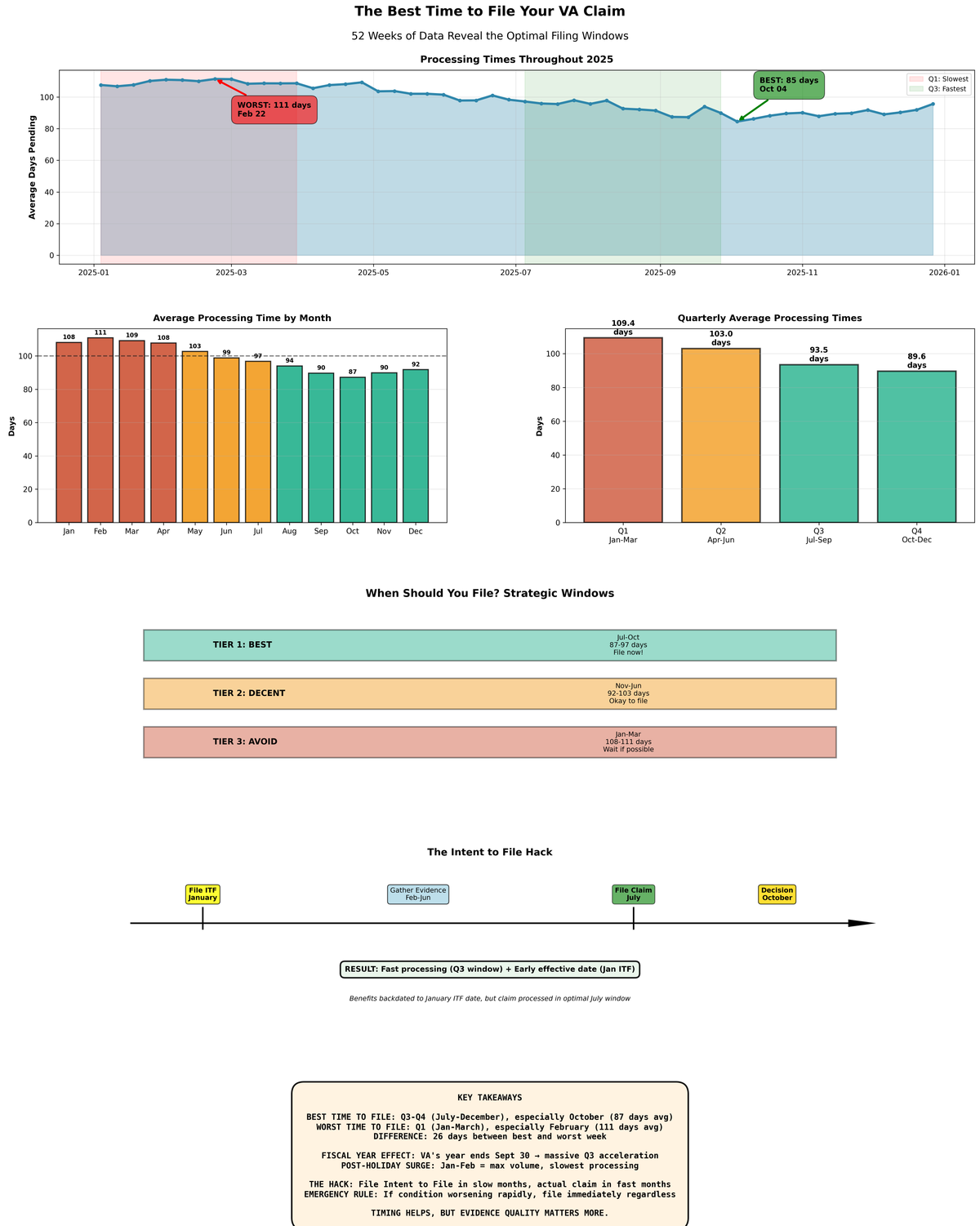
Timing matters. Filing in October vs February could save you 26 days of waiting.
TL;DR - The Answer
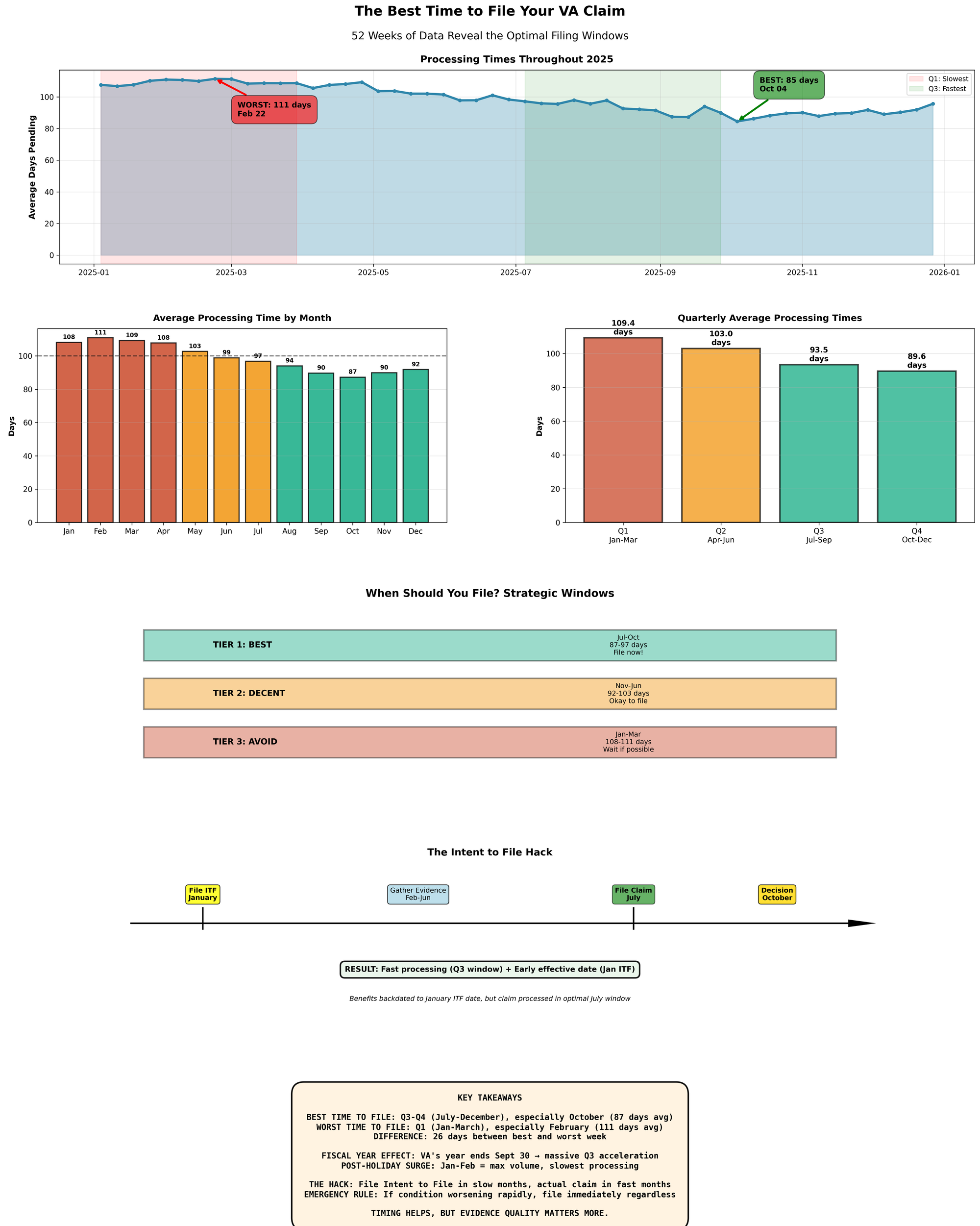
Best time to file: Q3-Q4 (July-December), especially October
Worst time to file: Q1 (January-March), especially February
Difference: 26 days faster processing in best vs worst week
Best week of 2025: October 4th (85 days average)
Worst week of 2025: February 22nd (111 days average)
The Data: 52 Weeks of Processing Times
I tracked VA processing times every single week of 2025. Here's what the data shows:
Monthly Breakdown
| Month | Avg Processing Time | Rating |
|---|---|---|
| January | 108 days | ⭐⭐ Bad |
| February | 111 days | ⭐ Worst |
| March | 109 days | ⭐⭐ Bad |
| April | 108 days | ⭐⭐ Fair |
| May | 103 days | ⭐⭐⭐ Good |
| June | 99 days | ⭐⭐⭐ Good |
| July | 97 days | ⭐⭐⭐⭐ Great |
| August | 94 days | ⭐⭐⭐⭐ Great |
| September | 90 days | ⭐⭐⭐⭐⭐ Best |
| October | 87 days | ⭐⭐⭐⭐⭐ Best |
| November | 90 days | ⭐⭐⭐⭐ Great |
| December | 92 days | ⭐⭐⭐⭐ Great |
Quarterly Pattern
Q1 (Jan-Mar): 109 days average - AVOID
Post-holiday surge, PACT Act backlog, new year filing rush
Q2 (Apr-Jun): 103 days average - Decent
Things start improving, backlog clearing
Q3 (Jul-Sep): 94 days average - EXCELLENT
End-of-fiscal-year push (Sept 30 deadline), VA accelerates
Q4 (Oct-Dec): 90 days average - BEST
Sustained momentum, lower volume, efficient processing
Why Timing Matters
The Fiscal Year Effect
The VA's fiscal year ends September 30. This creates massive pressure to close claims in Q3.
What happens:
- VA leadership pushes for strong end-of-year numbers
- Hiring freezes lift
- Overtime approved
- Processing accelerates dramatically
Result: August-September are the fastest months (90-94 days)
The Post-Holiday Surge
January-February are the worst months because:
- Veterans file after holidays - New Year's resolution to "finally file"
- PACT Act anniversary surge - Veterans remember eligibility
- Tax season motivation - Want benefits for tax filing
- Delayed processing - Holiday backlog from Dec
Result: February hits 111 days average
The Summer Sweet Spot
July-August are surprisingly fast despite summer vacations:
- Pre-fiscal-year-end push starts in July
- Lower filing volume - Veterans on vacation too
- Hiring complete - New staff from spring hiring fully trained
- Process improvements - Mid-year optimizations paying off
The Week-by-Week Story
Best Single Week: October 4, 2025 (85 days)
- Post-fiscal-year momentum
- Backlog cleared from Sept push
- Efficient steady-state operations
Worst Single Week: February 22, 2025 (111 days)
- Peak of post-holiday surge
- Maximum inventory levels
- Still working through Jan/Dec filings
26-day difference between best and worst week
Strategic Filing Windows
TIER 1: File Now (Best Times)
September-October
- Processing: 87-90 days
- Why: Fiscal year push + sustained momentum
- Caveat: File early September (before rush)
July-August
- Processing: 94-97 days
- Why: Pre-FY push, lower volume
- Bonus: Summer = less competition
TIER 2: Decent Times
November-December
- Processing: 90-92 days
- Why: Momentum continues
- Risk: Holiday slowdowns in late Dec
May-June
- Processing: 99-103 days
- Why: Backlog clearing, improvements showing
- Better than Q1 but not as good as Q3/Q4
TIER 3: Avoid If Possible
January-March
- Processing: 108-111 days
- Why: Post-holiday surge, max inventory
- Only file if you must (can't wait)
April
- Processing: 108 days
- Why: Still working through Q1 surge
- Starting to improve but not there yet
Special Timing Considerations
End of Month vs Beginning of Month
Beginning of month (1st-10th): Slightly faster
- Fresh monthly targets
- Raters starting with clean slate
End of month (21st-31st): Slightly slower
- Rush to hit monthly numbers (prioritizes old claims)
- Your new claim waits
Difference: 3-5 days typically
Day of Week
Monday-Wednesday: Best
- Fresh work week
- Full attention
Thursday-Friday: Slower
- End-of-week fatigue
- Weekend approaching
Weekends: Don't bother
- No processing happens
- Wait until Monday
Difference: Minimal (1-2 days) but exists
Holiday Weeks
Avoid filing:
- Week of Thanksgiving
- Week of Christmas
- Week of New Year's
- Memorial Day week
- July 4th week
Why: Skeleton crew, delayed processing, claim sits longer before initial review
The "Wait or File Now?" Decision
File Immediately If:
✅ You're in Q3-Q4 (July-December)
✅ Your evidence is complete
✅ You're in good health (condition not worsening rapidly)
✅ Your Regional Office is fast (check our RO rankings)
Consider Waiting If:
❌ It's January-February (wait until March minimum)
❌ You're missing key evidence (get it first, then file in good window)
❌ Major policy change coming (wait for favorable rule)
❌ Your RO is DC (always slow, timing matters less)
Never Wait For:
⚠️ "Perfect" timing - if you're ready, file
⚠️ A specific date - windows matter more than exact days
⚠️ End of month - beginning is better
⚠️ Your birthday/anniversary - sentimental but irrelevant
The Intent to File Hack
The Problem: You're in January (bad timing) but want to file
The Solution: File Intent to File (ITF)
How it works:
- File ITF in January (takes 2 minutes)
- Locks your effective date
- Gather evidence until July
- File actual claim in July (good timing)
- Get benefits backdated to January ITF date
Result: Best of both worlds - early effective date + fast processing
ITF gives you 1 year to file your actual claim.
Real-World Filing Strategies
Strategy #1: The Patient Approach
Scenario: It's February, you're ready to file
Action:
- File ITF today (locks Feb effective date)
- Spend Feb-June gathering evidence
- File actual claim in July
- Get decision in September-October
- Benefits backdated to February
Timeline: Feb ITF → July claim → Oct decision (8 months total)
vs. filing in Feb: Feb claim → May decision (3 months)
Trade-off: Longer total timeline but faster processing + better evidence = higher rating
Strategy #2: The Opportunist
Scenario: It's August, evidence is ready
Action:
- File immediately
- Ride the Q3 wave
- Get decision in 94 days (November)
Result: Fast filing + fast processing = quick decision
Strategy #3: The Emergency
Scenario: Condition worsening rapidly, any month
Action:
- File immediately regardless of timing
- Request expedited processing (if severe)
- Upload all evidence same day
- Follow up weekly
Why: Health > timing. File now.
2026 Predictions
Based on 2025 patterns, here's what to expect:
Best months to file in 2026:
- July-October (same fiscal year pattern)
- Especially September (FY end push)
Worst months in 2026:
- January-March (post-holiday surge repeats)
- Especially February (peak every year)
Wild cards:
- Major policy changes could shift patterns
- Staffing changes at VA
- New PACT Act expansions
Safe bet: Q3-Q4 will remain fastest, Q1 will remain slowest
The Bottom Line
Timing CAN save you 20-30 days of waiting.
Best practice:
- Check the calendar
- If it's Q3-Q4: File now
- If it's Q1-Q2: File ITF, wait until summer
- If it's Q2: Borderline, file if evidence is complete
- Always file early in month vs end of month
But remember:
- Perfect timing with weak evidence = denial
- Bad timing with strong evidence = approval
Evidence quality > timing, but timing still matters.
Want to check your Regional Office's specific timing patterns? Check our RO Power Rankings report.
-Landon
Building Claim Raven | U.S. Army Veteran
Not a lawyer or VSO. This is data analysis from 52 weeks of public VA reports.