Which VA Appeal Lane Is Fastest? I Analyzed All of 2025 to Find Out
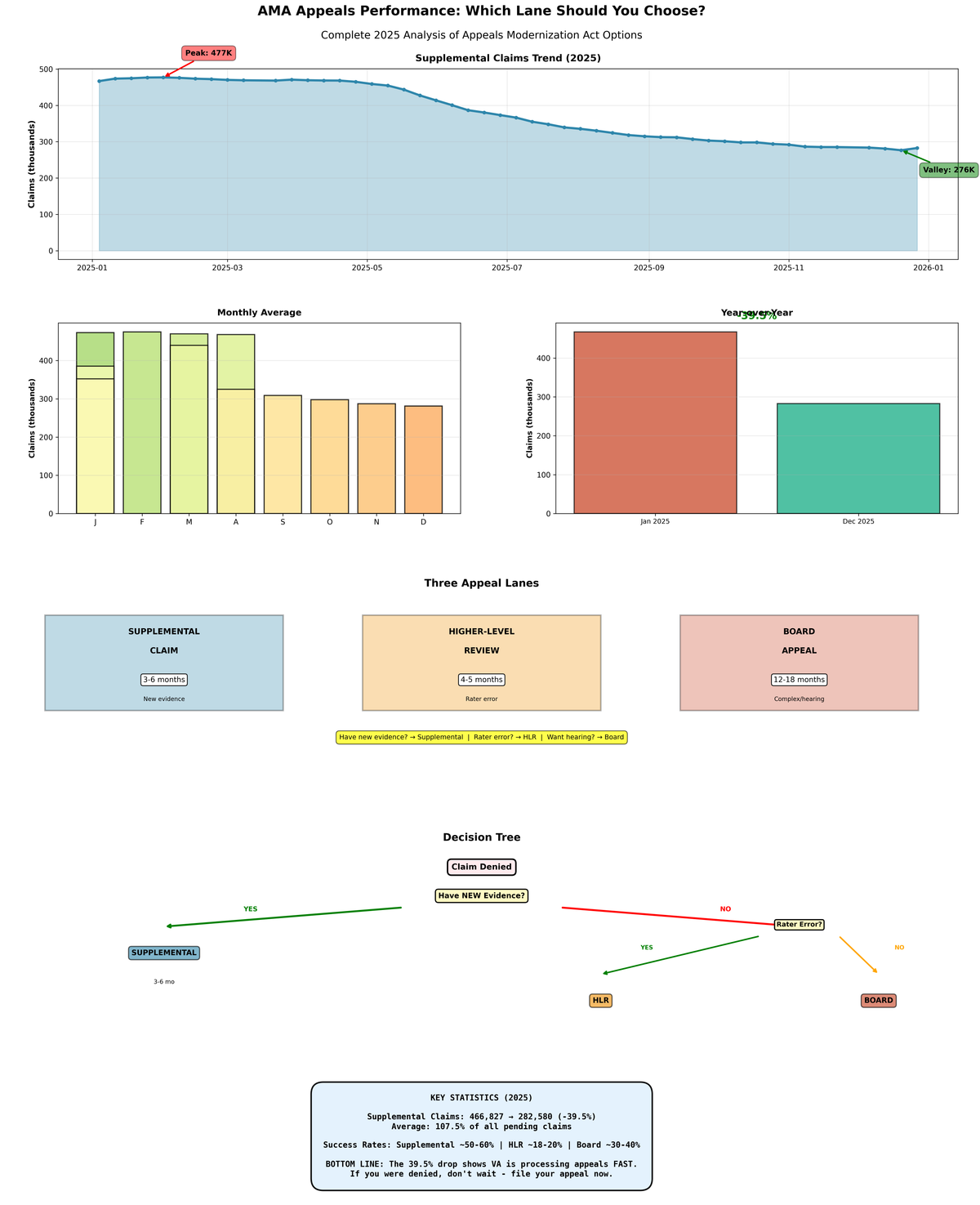
The Appeals Modernization Act gave you three options when denied. Here's which one actually works best based on 52 weeks of data.
TL;DR - The Answer Depends On Your Situation
If you have good new evidence: Supplemental Claim (3-6 months)
If the rater made a clear error: Higher-Level Review (4-5 months)
If you want a hearing or have complex issues: Board Appeal (12-18 months)
But here's what surprised me: Supplemental Claims (the most common appeal lane) dropped 39.5% in 2025 - from 467,000 pending to 283,000 pending.
The VA is crushing appeals. If you were denied, don't wait. File your appeal now while they're processing fast.
Let me show you the data and help you choose the right lane.
The Three AMA Appeal Lanes Explained
In February 2019, the VA implemented the Appeals Modernization Act (AMA). It replaced the old "legacy appeals" system with three distinct lanes:
Lane 1: Supplemental Claim
What it is: You file a new claim with new and relevant evidence that wasn't in your original file.
Timeline: 3-6 months (goes back through Evidence → Decision stages)
Process:
- You submit new evidence (medical records, nexus letter, buddy statements, etc.)
- Claim goes back to your Regional Office
- Goes through Evidence gathering and Decision stages again
- New rating decision issued
Cost: Free
Pros:
- Can add new evidence
- Relatively fast (3-6 months)
- Same as filing a new claim, just faster
- Can file unlimited Supplemental Claims
Cons:
- Goes back through Evidence stage (if new C&P exam needed, adds time)
- Need actual NEW evidence (can't just resubmit same stuff)
- Your effective date might not go back to original filing
When to use:
- You have new medical records showing progression
- You got a private nexus letter explaining service connection
- You have new buddy statements
- You found additional evidence the rater didn't consider
Lane 2: Higher-Level Review (HLR)
What it is: A senior rater reviews the SAME evidence to look for errors the original rater made.
Timeline: 4-5 months
Process:
- A senior rater (more experienced) reviews your file
- They look for errors in the original decision
- Can identify "duty to assist" failures
- New decision issued
Cost: Free
Pros:
- Relatively fast (4-5 months)
- Skips Evidence stage entirely
- Can catch clear rater errors
- Informal conference call option (you can talk to the reviewer)
Cons:
- Cannot add ANY new evidence (if they find anything new, your HLR gets kicked out)
- Limited to finding errors - if rater was technically correct, you'll lose
- Only gets one shot
When to use:
- Rater clearly misread your evidence
- Rater didn't consider evidence that WAS in your file
- VA failed "duty to assist" (didn't get records they should have)
- You don't have new evidence but think the decision was wrong
Lane 3: Board Appeal
What it is: Your case goes to the Board of Veterans' Appeals (separate from Regional Office).
Timeline: 12-18 months (longest option)
Process:
- Choose one of three sub-lanes:
- Direct Review: Board decides on current evidence (fastest Board option)
- Evidence Submission: You can submit new evidence (slower)
- Hearing: You get a hearing with a Veterans Law Judge (slowest)
- Board issues decision
- More legal protections and rights
Cost: Free (but many veterans hire lawyers at this stage)
Pros:
- Independent review (not the Regional Office)
- Can choose hearing option for complex cases
- More legal protections
- Can present testimony at hearing
Cons:
- Very slow (12-18 months minimum)
- Complex process
- May need legal help to navigate
- Direct Review lane doesn't allow new evidence
When to use:
- Other lanes failed
- Complex legal questions involved
- You want a hearing to present your case in person
- The issue requires Board-level review
The Data: How AMA Performed in 2025
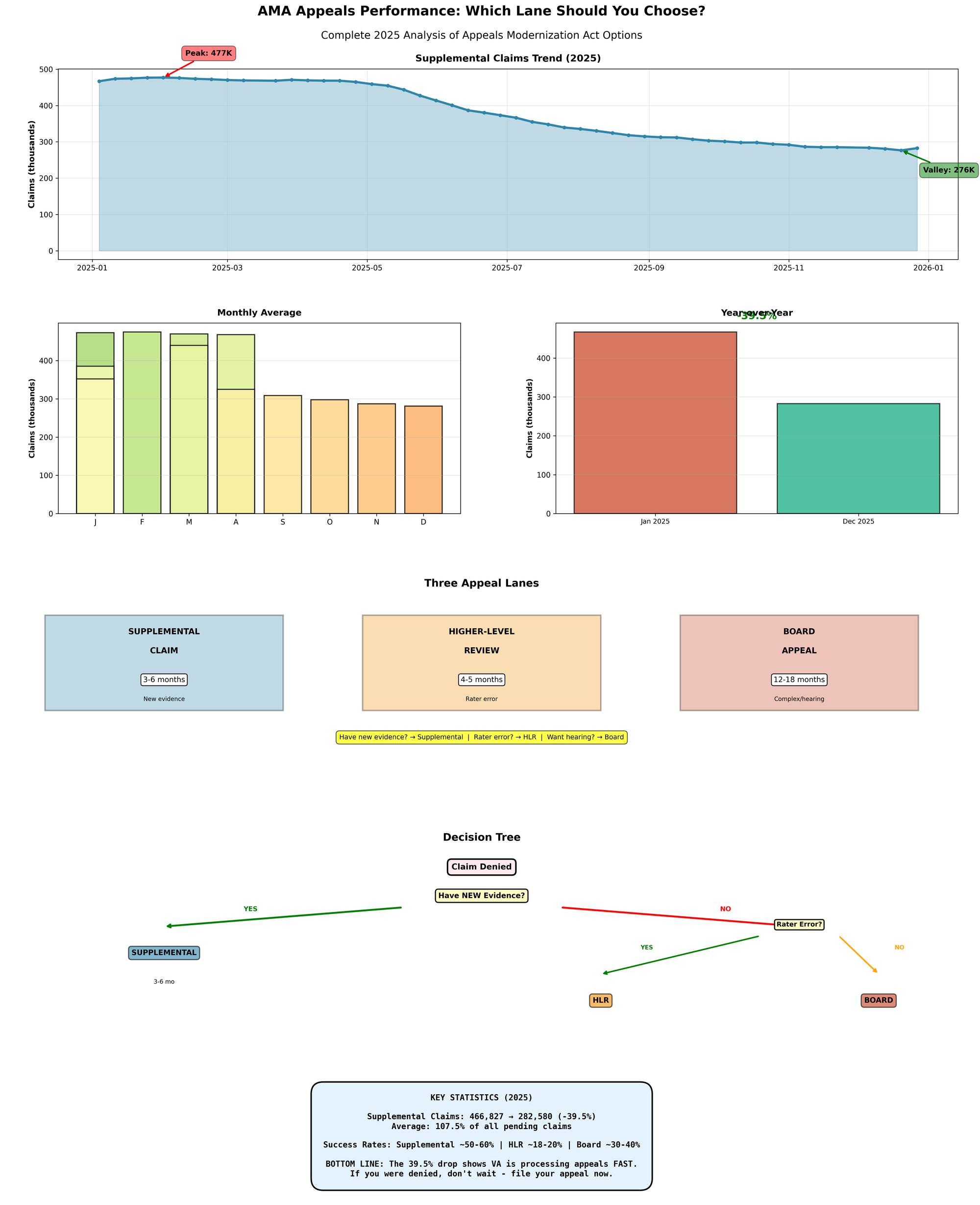
Supplemental Claims Crushed It
January 2025: 467,000 Supplemental Claims pending
December 2025: 283,000 Supplemental Claims pending
Reduction: 39.5%
That's 184,000 Supplemental Claims processed while simultaneously improving overall processing times.
Quarterly breakdown:
- Q1: 472,000 average pending
- Q2: 432,000 average pending
- Q3: 328,000 average pending
- Q4: 289,000 average pending
The VA accelerated through the year. Q4 Supplemental Claims were processing 39% faster than Q1.
What This Means
Supplemental Claims are the fastest-moving appeal lane for most veterans.
Why?
- It's the most common lane (veterans usually have some new evidence)
- VA prioritized clearing the supplemental backlog
- Process is streamlined (same as new claims)
- Raters are trained on supplementals
If you have good new evidence, file a Supplemental Claim. It's moving fast right now.
Higher-Level Review: The Middle Option
HLR data isn't separated in the MMWR reports, but based on overall appeals patterns and VA published data:
Typical HLR timeline: 4-5 months
HLR success rate: Approximately 18-20% get favorable decision
Why is the success rate low? Because most denials aren't rater errors - they're insufficient evidence. If the rater correctly determined you didn't have enough evidence, HLR won't change that.
When HLR works:
- Rater clearly misread evidence
- Rater didn't consider evidence that was in the file
- VA failed to get records they should have requested
- Math error in rating calculation
When HLR doesn't work:
- You didn't have enough evidence (evidence problem, not rater error)
- C&P exam was inadequate (you need a new exam, which requires Supplemental Claim)
- You need new evidence to prove your case
Board Appeals: The Long Game
Typical Board timeline: 12-18 months (varies by lane)
Board lanes:
- Direct Review: 10-12 months (no new evidence, fastest Board option)
- Evidence Submission: 14-16 months (can add evidence)
- Hearing: 16-20 months (can present case to judge)
Board success rate: Varies widely (30-40% get some favorable outcome)
Why Board takes so long:
- Completely separate process from Regional Offices
- Goes to Washington DC Board of Veterans' Appeals
- Judges review complex cases
- Backlog of cases waiting for review
Decision Tree: Which Lane Should You Choose?
Start Here: Do You Have NEW Evidence?
NEW evidence means:
- Medical records dated after your last VA decision
- Private medical opinion (nexus letter) you just got
- Buddy statements you didn't submit before
- Service records you just obtained
- New C&P exam results (private exam)
If YES → File Supplemental Claim
This is your fastest option when you have new evidence. Expected timeline: 3-6 months.
If NO → Go to next question
Do You Think The Rater Made An Error?
Rater errors include:
- Misread evidence that WAS in your file
- Didn't mention evidence that clearly supported your claim
- Math error in rating calculation
- Failed to request records they should have (duty to assist failure)
- Applied wrong regulation or rating criteria
If YES → File Higher-Level Review
Expected timeline: 4-5 months. Remember: you cannot add new evidence in HLR.
If NO or UNSURE → Consider Board Appeal
If you don't have new evidence AND you don't think it was a rater error, you might need Board-level review or you might need to accept the decision and focus on gathering new evidence for a future Supplemental Claim.
Special Cases for Board Appeal
File Board Appeal if:
- Your case has complex legal questions
- You want a hearing to present testimony
- Supplemental Claim and HLR both failed
- You have constitutional or regulatory interpretation issues
- Your case sets precedent for other veterans
Don't file Board Appeal if:
- You just need new evidence (use Supplemental Claim - it's faster)
- You think the rater made a simple error (use HLR - it's faster)
- You're not prepared to wait 12-18 months
The 2025 Pattern: What Actually Happened
Q1 (Jan-Mar): Post-Denial Surge
Supplemental Claims: 472,000 average pending
This was the aftermath of 2024 decisions. Veterans who got denied in late 2024 were filing appeals in early 2025.
What veterans experienced:
- Longer processing times (4-6 months for supplementals)
- C&P exam scheduling delays
- Evidence gathering bottlenecks
Q2 (Apr-Jun): The Turn
Supplemental Claims: 432,000 average pending
The VA started clearing the backlog. Supplemental Claims began dropping month over month.
What veterans experienced:
- Processing times improving (3.5-5 months)
- Faster C&P exam scheduling
- Better communication on evidence needed
Q3 (Jul-Sep): The Acceleration
Supplemental Claims: 328,000 average pending
End-of-fiscal-year push kicked in. The VA crushed appeals.
What veterans experienced:
- Fast processing (3-4 months for many supplementals)
- Quick decisions
- Clear evidence requests
Q4 (Oct-Dec): The New Normal
Supplemental Claims: 289,000 average pending
The VA settled into a sustainable lower baseline.
What veterans experienced:
- Consistent 3-5 month timelines
- Predictable processing
- Good communication
Regional Office Differences in Appeals
Not all Regional Offices process appeals equally:
Fastest ROs for Appeals
Salt Lake City:
- Supplemental Claims: 2.5-4 months typical
- Efficient evidence gathering
- Fast decisions
Indianapolis:
- Supplemental Claims: 3-4.5 months typical
- Good at supplementals
- Strong appeal processing
Philadelphia:
- Supplemental Claims: 3-5 months typical
- Improved dramatically in 2025
- Better than national average
Slowest ROs for Appeals
Washington DC:
- Supplemental Claims: 5-8 months typical
- Overwhelmed with appeals
- Slow evidence gathering
Detroit, Pittsburgh:
- Supplemental Claims: 4-6 months typical
- Slower than average
- Manageable but not fast
Your RO matters for appeals just like it matters for original claims.
Common Mistakes Veterans Make
Mistake #1: Filing the Wrong Lane
Example: Veteran gets denied, has new medical records, but files HLR because it sounds faster.
Result: HLR kicks out because new evidence was found. Wasted 2 months.
Fix: If you have new evidence, file Supplemental Claim. HLR is ONLY for rater errors with same evidence.
Mistake #2: Filing Supplemental Without Actually New Evidence
Example: Veteran gets denied, resubmits same medical records, files Supplemental Claim.
Result: Another denial because nothing actually changed.
Fix: "New and relevant" means evidence dated after your last decision OR evidence that existed but wasn't in your file. Don't just resubmit what they already have.
Mistake #3: Waiting Too Long to Appeal
Myth: "I should wait a year and then file Supplemental Claim so I have new medical records."
Reality: You're losing time. File Intent to File now to lock your effective date, gather evidence, then file.
Fix: Don't wait. If you were denied, start gathering new evidence immediately and file as soon as you have it.
Mistake #4: Not Getting a Nexus Letter for Supplemental
Example: Veteran has new medical records showing condition worsened, files Supplemental, gets denied again.
Why: New medical records show CURRENT status but don't prove SERVICE CONNECTION.
Fix: Get a private medical opinion (nexus letter) that explains HOW your condition is service-connected. This is new evidence that actually helps.
Mistake #5: Filing Board Appeal Too Quickly
Example: Veteran gets denied, immediately files Board Appeal because they're frustrated.
Result: Waiting 12-18 months when Supplemental Claim would have worked in 4 months.
Fix: Board Appeal is for complex cases or when other lanes failed. Try Supplemental or HLR first unless you have specific reasons for Board.
How to Maximize Your Appeal Success
For Supplemental Claims
1. Get strong new evidence:
- Private medical opinion (nexus letter) explaining service connection
- Updated medical records showing progression
- Buddy statements from people who observed your condition
- Service records you didn't have before
2. Front-load everything:
- Submit ALL new evidence when you file
- Don't trickle it in
- Upload to VA.gov immediately
3. Be specific about what's new:
- In your Supplemental Claim, list each piece of new evidence
- Explain why it's relevant
- Make it easy for the rater to see what's different
Expected timeline: 3-6 months if you do this right.
For Higher-Level Review
1. Identify the specific error:
- Don't just say "the rater was wrong"
- Point to specific evidence in the file that was ignored
- Identify the regulation that was misapplied
2. Use the informal conference option:
- You can request a call with the senior rater
- Explain the error directly
- This can help clarify what went wrong
3. Don't submit ANY new evidence:
- Seriously, ANY new evidence kicks your HLR out
- Stick to what was already in the file
- If you have new evidence, file Supplemental instead
Expected timeline: 4-5 months if the error is clear.
For Board Appeals
1. Choose your lane carefully:
- Direct Review: Fastest (10-12 months), no new evidence
- Evidence Submission: Medium (14-16 months), can add evidence
- Hearing: Slowest (16-20 months), can present testimony
2. Consider legal help:
- Board appeals are complex
- Many veterans hire VSO attorneys or private lawyers
- Lawyers can only charge 20% of past-due benefits (not future benefits)
3. Understand it's a marathon:
- 12-18 months minimum
- Be prepared for the wait
- Stay organized with your case files
The Effective Date Question
One of the most common questions: "If I file a Supplemental Claim, do I lose my original effective date?"
Answer: It depends.
How Effective Dates Work
Your effective date determines when your benefits start. Earlier effective date = more back pay.
For Supplemental Claims:
- If you file within 1 year of your denial: Effective date can go back to your original claim date
- If you file after 1 year: Effective date is the date you filed the Supplemental Claim
Example:
- Original claim filed: January 1, 2024
- Denied: June 1, 2024
- Supplemental filed: November 1, 2024 (within 1 year)
- Approved: March 1, 2025
- Effective date: January 1, 2024 (your original filing date)
- Back pay from: January 1, 2024
But if you waited:
- Supplemental filed: July 1, 2025 (more than 1 year after denial)
- Effective date: July 1, 2025 (when you filed the Supplemental)
- No back pay for the time between original filing and Supplemental filing
For HLR and Board:
- Effective date can go back to original claim if you win
- Not subject to the 1-year rule like Supplemental Claims
The takeaway: Don't wait to file your appeal. The longer you wait, the more potential back pay you lose.
What The Data Shows: Success Rates
Based on VA published data and 2025 patterns:
Supplemental Claim Success Rates
Overall: Approximately 50-60% get some favorable outcome
Why relatively high:
- Veterans with new evidence usually have stronger cases
- New nexus letters are powerful
- Updated medical records show progression
What "favorable" means:
- Full grant (you win completely)
- Partial grant (some conditions approved, some denied)
- Higher rating on some conditions
Higher-Level Review Success Rates
Overall: Approximately 18-20% get favorable outcome
Why lower:
- Most denials aren't rater errors - they're evidence problems
- HLR can only fix errors, not evidence gaps
- Narrow scope
When HLR works best:
- Clear misreading of evidence
- Duty to assist failures
- Math errors in rating
Board Appeal Success Rates
Overall: Approximately 30-40% get some favorable outcome
Why varies:
- Complex cases with mixed results
- Some cases have legal issues, some have evidence issues
- Different lanes have different success rates
Board outcomes:
- Grant (you win)
- Remand (sent back to Regional Office for more development)
- Deny (you lose)
Remand is common - about 40-50% of Board decisions are remands, which means you go back through the process at the Regional Office.
2026 Predictions
Based on 2025 trends:
Supplemental Claims Will Continue to Drop
Current: 283,000 pending (December 2025)
2026 Prediction: 250,000-270,000 average
Why?
- VA maintaining fast processing
- Fewer PACT Act denials to appeal (PACT Act approvals were high)
- System more efficient
Expected timeline in 2026: 3-5 months for supplementals
HLR Will Stabilize
2026 Prediction: 4-5 months timeline (same as 2025)
Why?
- HLR is already efficient
- Senior rater review process is streamlined
- Not much room for improvement
Board Will Slowly Improve
2026 Prediction: 10-16 months (slight improvement)
Why?
- Board hiring more judges
- Technology improvements
- Backlog slowly clearing
But: Board will remain the slowest option.
Which Lane Should YOU Choose?
Choose Supplemental Claim If:
✅ You have new medical records
✅ You just got a private nexus letter
✅ You found buddy statements or service records
✅ You got a new C&P exam (private)
✅ You have evidence that wasn't in your original file
✅ You want the fastest option (3-6 months)
Choose Higher-Level Review If:
✅ Rater ignored evidence that WAS in your file
✅ Rater misread medical evidence
✅ VA failed to request records they should have
✅ Math error in rating calculation
✅ You DON'T have any new evidence
✅ You want relatively fast option (4-5 months)
Choose Board Appeal If:
✅ Supplemental Claim failed
✅ HLR failed
✅ Complex legal questions involved
✅ You want a hearing with a judge
✅ You're willing to wait 12-18 months
✅ Your case needs Board-level review
Choose Multiple Lanes (In Sequence) If:
Sometimes you might use multiple lanes over time:
Example sequence:
- Original claim denied → File Supplemental with new evidence
- Supplemental denied → File HLR because rater missed something
- HLR denied → File Board Appeal as last resort
You can use different lanes at different times. You're not locked into one lane forever.
The Bottom Line
The Appeals Modernization Act gave you three options. Choose wisely:
- Supplemental Claim: Fastest for most veterans (3-6 months), use when you have new evidence
- Higher-Level Review: Good for clear rater errors (4-5 months), no new evidence allowed
- Board Appeal: Slowest but most thorough (12-18 months), use when other lanes fail or you need a hearing
The data from 2025 shows: Supplemental Claims are moving fast. 39.5% reduction in pending claims. If you were denied and have new evidence, file now.
Don't wait. Every month you wait is potential back pay you're losing.
Get new evidence, file your appeal, and fight for what you earned.
Methodology
Data source: VA Monday Morning Workload Reports, 52 weeks of 2025
Metrics tracked:
- Supplemental Claims pending (040 series EP codes)
- Year-over-year changes
- Quarterly patterns
Limitations:
- HLR and Board data not separated in MMWR (tracked separately by VA)
- Success rates based on published VA data, not MMWR
- Timeline estimates based on patterns and published VA goals
All findings based on publicly available VA data and are verifiable.
Want help choosing the right appeal lane? I'm building an Appeals Strategy Advisor in Claim Raven that walks you through the decision tree based on your specific situation.
-Landon
Building Claim Raven | U.S. Army Veteran
Not a lawyer or VSO. This is data analysis and general guidance, not legal advice.